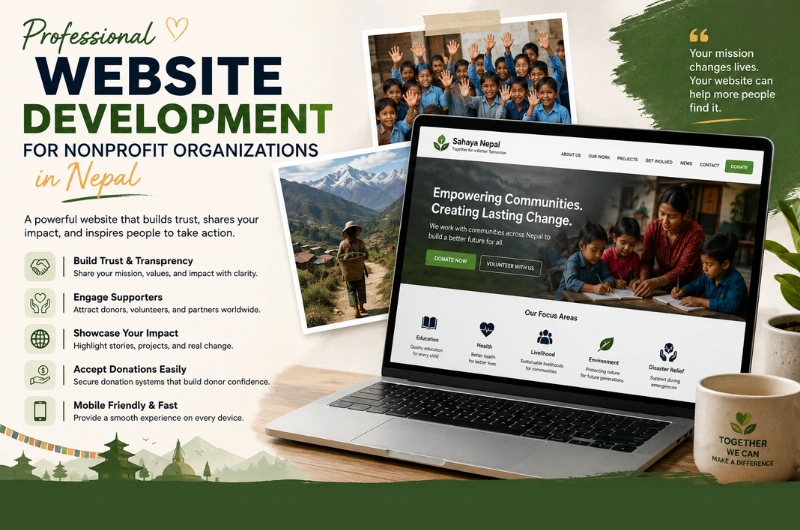
A strong online presence is important for every nonprofit organization working in Nepal. Whether your organization focuses on education, health, child welfare, environment, community development, women’s empowerment, disaster response, or another social cause, your website can help people understand your work and support your mission.
For many people, your website is the first place they look before trusting an organization. Donors may want to understand your projects. Volunteers may want to know how they can help. Partners may want to learn about your work. Beneficiaries may need information about your programs and services.
This makes professional website development for nonprofit organizations in Nepal more than a design project. Your website should communicate your mission, demonstrate credibility, share your impact, and make it easy for people to take action.
A well-developed nonprofit website can help you:
- Build trust and credibility
- Explain your mission and programs
- Showcase projects and social impact
- Attract donors and supporters
- Recruit volunteers
- Publish reports and updates
- Receive inquiries and applications
- Promote campaigns and events
- Improve visibility in Google search
- Connect with local and international audiences
Whether you are a small community-based organization in Nepal or an established NGO working across multiple districts, your website should be designed around your organization’s goals and the people you serve.
What Is Nonprofit Website Development?
Nonprofit website development is the process of planning, designing, developing, testing, launching, and maintaining a website for a nonprofit organization, NGO, charity, foundation, or social-impact organization.
Unlike a standard business website, a nonprofit website needs to communicate both information and impact.
Visitors may want to know:
- What does the organization do?
- Why does the organization exist?
- Who benefits from its work?
- Where does it operate?
- What projects has it completed?
- How can I donate?
- How can I volunteer?
- How can I become a partner?
- Where can I find reports and publications?
- How can I contact the organization?
A professional website brings these answers together in one easy-to-use platform.
The website can include pages and features such as:
- About the organization
- Mission and vision
- Programs and projects
- Impact stories
- Annual reports
- News and updates
- Events
- Donation information
- Volunteer applications
- Contact forms
- Photo and video galleries
- Publications and resources
- Team information
- Partner information
- Careers
- Multiple languages
- Social media integration
- Google Maps
- Search engine optimization
The exact features should depend on the organization’s needs.
Why Do Nonprofit Organizations in Nepal Need a Professional Website?
Social media is useful for nonprofit organizations, but it should not be the only place where people learn about your organization.
A social media profile can help you share updates and reach followers. Your website, however, gives your organization a central online platform that you control.
A professional website can help a nonprofit organization present its work clearly and consistently.
Build Trust and Credibility
People are more likely to support an organization when they can easily find information about it.
Your website can provide:
- Organization history
- Registration and organizational information
- Leadership details
- Programs
- Project locations
- Reports
- Publications
- Contact details
- Partner information
- Success stories
Clear information helps visitors understand who you are and what your organization does.
Show the Impact of Your Work
Nonprofit organizations are often judged by the difference they make.
Instead of only saying that your organization supports communities, show what that support looks like.
For example, you could publish:
- Number of people reached
- Number of schools supported
- Communities served
- Training programs completed
- Healthcare initiatives
- Environmental activities
- Project outcomes
- Beneficiary stories
Use real information and explain it clearly.
Attract Donors and Supporters
A website can provide potential donors with the information they need before they decide to support your organization.
A dedicated donation section can explain:
- What the organization does
- Where donations are used
- How people can contribute
- Available payment methods
- Donation campaigns
- Contact information
For international supporters, the website can also provide relevant information about supporting projects from outside Nepal.
Recruit Volunteers
Many nonprofit organizations depend on volunteers.
A website can make recruitment easier by providing:
- Volunteer opportunities
- Requirements
- Available roles
- Application forms
- Program information
- Volunteer stories
This gives interested people a clear way to get involved.
What Should a Nonprofit Website in Nepal Include?
Every organization has different needs, but most nonprofit websites should provide a clear set of core pages.
| Website Page | Purpose |
|---|---|
| Home | Introduce the organization and key actions |
| About Us | Explain history, mission, and vision |
| Programs | Explain major areas of work |
| Projects | Showcase specific projects and activities |
| Impact | Demonstrate measurable results |
| News & Updates | Share recent activities |
| Reports | Provide reports and publications |
| Get Involved | Encourage volunteering and support |
| Donate | Explain donation options |
| Contact | Provide contact and location information |
Larger organizations may also need pages for careers, partners, events, resources, regional offices, publications, and individual projects.
The goal is not to create as many pages as possible.
The goal is to create the right pages for your visitors.
Key Features of Professional NGO Website Development
A nonprofit website should make information easy to find and important actions easy to complete.
1. Clear and Professional Homepage
The homepage should quickly explain:
- Who you are
- What you do
- Where you work
- Who you help
- What impact you create
- How visitors can support your work
A strong homepage may include calls to action such as:
Donate | Volunteer | Explore Our Programs | Contact Us
Avoid filling the homepage with long blocks of text.
Use short sections, clear headings, meaningful images, statistics, project highlights, and calls to action.
2. Mission, Vision, and Values
Your mission explains why your organization exists.
Your vision describes the change you want to create.
Your values explain the principles that guide your work.
These should be easy to find on your website.
For an NGO, this information is not just corporate content. It helps donors, volunteers, partners, and communities understand your purpose.
3. Programs and Projects
Create clear pages for your major programs.
For example, an organization working in Nepal might have programs related to:
- Education
- Healthcare
- Child protection
- Women’s empowerment
- Agriculture
- Environment
- Disaster response
- Community development
- Livelihood development
Each program page should explain:
- The problem
- What the organization does
- Where the program operates
- Who benefits
- Key activities
- Results or progress
This structure makes your work easier to understand.
4. Impact and Success Stories
Impact content can make a nonprofit website more engaging.
You can showcase:
- Project results
- Case studies
- Beneficiary stories
- Before-and-after outcomes
- Community testimonials
- Project photographs
- Videos
- Statistics
Use real stories and verified information.
Avoid exaggerating results simply to make the organization look more successful.
5. Donation Information
If your organization accepts donations, the donation process should be easy to understand.
Your website can explain:
- Why donations are needed
- What specific campaigns support
- How to donate
- Available payment options
- How donors can contact the organization
- How donations support projects
If online donation functionality is required, the website can integrate an appropriate payment gateway or donation platform.
The payment solution should be selected based on your organization’s location, donor base, currency requirements, and payment needs.
6. Volunteer Registration
A volunteer page can help organizations attract people who want to contribute their time and skills.
The page can include:
- Available opportunities
- Volunteer requirements
- Time commitments
- Locations
- Responsibilities
- Application form
- Frequently asked questions
Keep the application process simple.
Ask only for information your organization actually needs.
7. News and Updates
Regular updates show that your organization is active.
A nonprofit blog or news section can cover:
- New projects
- Project milestones
- Community events
- Training programs
- Campaigns
- Volunteer activities
- Organizational announcements
- Partnerships
- Achievements
Fresh content can also create additional opportunities to appear in search engines.
8. Annual Reports and Publications
Nonprofit organizations often have important documents that supporters and partners may want to review.
Your website can provide a resource section for:
- Annual reports
- Financial reports
- Project reports
- Research papers
- Policy documents
- Publications
- Brochures
- Newsletters
Organize these resources clearly so visitors can find the right document.
9. Contact and Location Information
Your contact page should make it easy for people to reach your organization.
Include relevant information such as:
- Office address
- Phone number
- Email address
- Office hours
- Google Maps
- Social media profiles
- Contact form
If your organization operates in multiple locations, consider creating separate location information for each office.
10. Team and Leadership Pages
People often want to know who is behind an organization.
Depending on your organization, you can introduce:
- Board members
- Executive leadership
- Program managers
- Key staff
- Advisors
Use accurate information and keep the page updated when leadership changes.
Mobile-Friendly Website Development for NGOs
A nonprofit website must work well on smartphones.
Visitors may access your website from:
- Smartphones
- Tablets
- Laptops
- Desktop computers
This is especially important when organizations work with communities where mobile devices are a major way of accessing the internet.
A mobile-friendly website should allow users to:
- Read project information
- View reports
- Contact the organization
- Submit forms
- Explore programs
- Make donations where supported
- Register as volunteers
Buttons should be easy to tap, text should be readable, and pages should load efficiently.
Responsive design should be part of the development process from the start.
Website Design for Nonprofit Organizations in Nepal
A nonprofit website should look professional without losing its human side.
People want to see the real work behind the organization.
Use authentic images of:
- Communities
- Programs
- Staff
- Volunteers
- Training sessions
- Field activities
- Events
- Projects
Avoid using generic stock photos when real project photography is available and appropriate.
Tell Your Story Clearly
A nonprofit website should answer a simple question:
Why should someone care about this organization’s work?
Your content should explain the problem, your approach, and the results in simple language.
For example:
Instead of writing:
“We facilitate multidimensional interventions for sustainable socioeconomic transformation.”
A clearer version might be:
“We help rural families improve their income through skills training, farming support, and local business opportunities.”
Simple language makes your work easier to understand.
NGO Website Development and SEO in Nepal
A professional website needs to be discoverable.
SEO for nonprofit organizations helps your website appear when people search for your organization, programs, causes, services, and relevant topics.
Potential searches may include:
- NGO in Nepal
- nonprofit organizations in Nepal
- charity organizations in Nepal
- education NGO in Nepal
- child welfare organization Nepal
- environmental NGO Nepal
- volunteer opportunities Nepal
- donate to charity in Nepal
- nonprofit organization Kathmandu
- community development organization Nepal
Your actual keywords should match your organization’s work.
Do not target keywords simply because they have search volume.
Create Useful Program Pages
If your organization works in several areas, create dedicated pages for important programs.
For example:
Education Programs
Healthcare Programs
Women’s Empowerment Programs
Environmental Projects
Each page can target relevant search queries while providing useful information to visitors.
Use Nepal Locations Naturally
If your organization works in specific locations, mention them where relevant.
For example:
- Kathmandu
- Lalitpur
- Bhaktapur
- Pokhara
- Chitwan
- Dolakha
- Sindhupalchok
Only mention locations where your organization actually operates.
Location-based content can help people find relevant programs and services.
Local SEO for Nonprofit Organizations in Nepal
If your NGO has a physical office or provides services in a specific area, local SEO can improve online visibility.
Make sure your website clearly provides:
- Organization name
- Office address
- Phone number
- Email address
- Location
- Office hours
- Service areas
You should also maintain consistent organization information across relevant online profiles and directories.
A properly optimized location page can help people find your office and understand where your organization works.
Website Accessibility for Nonprofit Organizations
Nonprofit organizations often serve diverse communities.
Website accessibility should therefore be considered during development.
Important practices include:
- Readable font sizes
- Good color contrast
- Descriptive image alt text
- Keyboard-friendly navigation
- Clear headings
- Accessible forms
- Easy-to-understand language
- Descriptive links
Accessibility is not only about technical standards.
It is also about making information easier for people to understand and use.
Multilingual NGO Websites in Nepal
Nepal is multilingual, and nonprofit organizations may communicate with different communities.
Depending on your audience, your website may need content in:
- English
- Nepali
- Other relevant languages
English may be useful for international donors, development partners, and international visitors.
Nepali or another local language may be more useful for communities and local audiences.
A multilingual website should use accurate translations.
Do not rely entirely on automatic translation for important organizational information.
Website Security for Nonprofit Organizations
Security is important for every website, including nonprofit websites.
An NGO website may collect information through:
- Contact forms
- Volunteer applications
- Donation forms
- Event registrations
- Newsletter subscriptions
Security measures may include:
- HTTPS/SSL
- Secure hosting
- Strong administrator passwords
- Regular software updates
- Reliable backups
- Spam protection
- Secure forms
- Access controls
- Trusted payment providers
If your website handles donations or personal information, security should be considered during the planning stage.
Website Speed and Performance
A nonprofit website should not require a fast internet connection just to load basic information.
Large images, unnecessary scripts, and poorly optimized websites can create a slow experience.
Professional development should consider:
- Image compression
- Proper image sizes
- Modern image formats
- Efficient code
- Good hosting
- Browser caching
- Reduced unnecessary scripts
- Mobile performance
A faster website improves usability and can also support search engine performance.
How Website Development Can Help NGOs Raise Awareness
A nonprofit website can become the central place where your organization tells its story.
For example, a visitor might discover your organization through Google.
They can then:
- Read about your mission.
- Explore your programs.
- View project results.
- Read a beneficiary story.
- Learn how to support the organization.
- Donate, volunteer, or contact your team.
This creates a clear journey from awareness to action.
Your website can support several types of visitors at the same time.
| Visitor | What They May Need |
|---|---|
| Donor | Impact, transparency, donation information |
| Volunteer | Opportunities and application details |
| Partner | Programs, organizational information, contact details |
| Beneficiary | Services, programs, locations, contact information |
| Journalist | Facts, reports, media information |
| Researcher | Publications, reports, project information |
| Job seeker | Careers and vacancies |
A well-planned website makes these journeys easier.
Website Development for NGOs: The Development Process
A professional nonprofit website should begin with planning rather than design.
Step 1: Understand the Organization
The development team should understand:
- Mission
- Vision
- Programs
- Target audiences
- Locations
- Projects
- Funding model
- Communication goals
- Website goals
This helps determine what the website actually needs.
Step 2: Identify Website Visitors
Different visitors have different needs.
Your website structure should consider:
- Donors
- Volunteers
- Beneficiaries
- Partners
- Staff
- Media
- Researchers
- General visitors
Step 3: Plan the Website Structure
Create a clear sitemap.
A typical nonprofit website might include:
- Home
- About
- Programs
- Projects
- Impact
- News
- Reports
- Get Involved
- Donate
- Contact
Larger organizations may need additional pages.
Step 4: Design the User Experience
The website should make important information easy to find.
For example, someone looking for your latest annual report should not need to click through five unrelated pages.
Step 5: Design the Website
The visual design should reflect the organization’s identity.
Use:
- Organization logo
- Brand colors
- Authentic photography
- Clear typography
- Consistent layouts
The design should feel professional but remain easy to use.
Step 6: Develop the Website
The development stage may include:
- Responsive design
- Content management system
- Contact forms
- Donation integration
- Volunteer forms
- Event management
- Blog or news system
- Document downloads
- Maps
- SEO setup
- Security features
Step 7: Add and Optimize Content
Content should be clear, accurate, and easy to read.
Review:
- Organization details
- Project information
- Contact information
- Reports
- Statistics
- Images
- Team information
Step 8: Test Everything
Test the website on:
- Smartphones
- Tablets
- Desktop computers
- Different browsers
Test forms, menus, links, downloads, donation systems, and other important features.
Step 9: Launch the Website
After testing, the website can be launched.
Set up appropriate:
- Analytics
- Search engine tools
- Security
- Backups
- Performance monitoring
Step 10: Maintain the Website
A nonprofit website should be updated regularly.
Maintenance may include:
- Software updates
- Security checks
- Backups
- New project updates
- New reports
- Staff updates
- Event updates
- SEO improvements
- Performance checks
An outdated website can make an active organization appear inactive.
Basic vs Custom Nonprofit Website Development
Not every nonprofit organization needs a large custom website.
| Website Type | Suitable For | Common Features |
|---|---|---|
| Basic NGO website | Small organizations | Home, About, Programs, Contact |
| Professional nonprofit website | Growing organizations | Programs, Projects, News, Reports, Forms |
| Donation-focused website | Fundraising organizations | Campaigns, Donations, Payment Integration |
| Custom NGO website | Larger organizations | Custom systems and integrations |
| Multi-location website | National organizations | Offices, Projects, Location Pages |
The right solution depends on your organization’s size, goals, budget, and future plans.
A small community organization may need a simple and easy-to-manage website.
A larger NGO may require a custom platform with project management, donation systems, multilingual content, or other integrations.
How Much Does Nonprofit Website Development Cost in Nepal?
The cost of website development for nonprofit organizations in Nepal depends on the website’s size, design, functionality, and integrations.
A basic website may include:
- Home
- About
- Programs
- Projects
- Contact
- Basic gallery
A larger nonprofit website may require:
- Online donations
- Payment integration
- Volunteer registration
- Event management
- Multiple languages
- Project pages
- Report library
- Advanced search
- Multiple office locations
- Custom forms
- Third-party integrations
- Advanced SEO
Factors That Affect Website Development Cost
The final cost can depend on:
- Number of pages
- Custom design
- Content requirements
- Number of programs
- Number of locations
- Donation functionality
- Payment integration
- Multilingual support
- Custom features
- Third-party integrations
- SEO requirements
- Content migration
- Website maintenance
There is no single price that fits every nonprofit organization.
The best approach is to define your requirements first and then select a website solution that fits your organization’s needs and budget.
How to Choose a Website Development Company for Your NGO
Choosing a website development partner is an important decision.
Before hiring a company, consider the following.
Do They Understand Nonprofit Websites?
An NGO website has different needs from a standard company website.
The development team should understand:
- Programs
- Projects
- Impact stories
- Donations
- Volunteers
- Reports
- Events
- Community-focused content
Can They Build a Mobile-Friendly Website?
Ask to see previous responsive website projects.
Your website should work well on smartphones and other devices.
Can They Integrate Donation and Payment Systems?
If your organization accepts online donations, ask whether the development company can integrate the payment system you need.
Do They Understand SEO?
A professional website should be built with search visibility in mind.
Ask about:
- Page structure
- URLs
- Metadata
- Mobile performance
- Website speed
- Local SEO
- Search engine indexing
Can Your Team Manage the Website?
Your staff should be able to update basic content when needed.
Ask whether the website includes a content management system and whether training is provided.
Do They Provide Ongoing Support?
Ask about:
- Maintenance
- Updates
- Security
- Backups
- Technical support
- Content changes
Long-term support can make website management easier for nonprofit organizations with limited technical resources.
Common NGO Website Mistakes to Avoid
1. Focusing Only on the Organization
Do not make every page about the organization.
Explain how your work helps people and communities.
2. Making the Mission Difficult to Understand
Use simple language.
Visitors should understand what your organization does within a few seconds.
3. Hiding Important Information
Do not hide contact details, programs, reports, or donation information.
4. Using Outdated Content
Old project information, outdated staff profiles, and expired campaigns can reduce trust.
5. Ignoring Mobile Users
Your website should work well on smartphones.
6. Using Too Many Stock Photos
Real project images can communicate your work better when they are available and appropriate to use.
7. Making Donations Difficult
If fundraising is important, make the donation process easy to understand.
8. Ignoring Website Security
Forms, accounts, and donation systems need appropriate security.
9. Forgetting SEO
A useful website still needs to be discoverable.
10. Launching Without a Maintenance Plan
A website requires updates after launch.
Plan for maintenance from the beginning.
Why Choose Webtech Nepal for Nonprofit Website Development?
Webtech Nepal provides professional website design and development services for organizations in Nepal and international markets.
For nonprofit organizations, we can help develop websites that communicate your mission, showcase your projects, provide useful resources, and make it easier for visitors to get involved.
Depending on your organization’s needs, we can help with:
- Nonprofit website design
- NGO website development
- Responsive website development
- Program and project pages
- Donation integration
- Volunteer registration forms
- Contact forms
- Event pages
- News and blog sections
- Report and document libraries
- Google Maps integration
- Local SEO
- Website speed optimization
- Website security
- Content management
- Website maintenance
- Custom functionality
We understand that nonprofit organizations have different goals and audiences.
A small community organization may need a simple website that explains its work and provides contact information.
A larger NGO may need a website with multiple programs, project pages, reports, donation functionality, volunteer registration, and multiple locations.
The website should be built around the organization’s actual needs rather than unnecessary features.
Frequently Asked Questions
What is website development for nonprofit organizations?
Website development for nonprofit organizations is the process of creating a website that helps an NGO or nonprofit communicate its mission, programs, projects, impact, and opportunities for people to support its work.
Why does an NGO in Nepal need a professional website?
A professional website can help an NGO build credibility, explain its programs, reach donors and partners, recruit volunteers, publish reports, share project updates, and improve its online visibility.
What should an NGO website include?
An NGO website should usually include information about the organization, mission, programs, projects, impact, news, reports, contact details, and ways to get involved. Donation and volunteer features can be added when needed.
Can an NGO website accept online donations?
Yes. An NGO website can integrate an appropriate online donation or payment system. The right solution depends on the organization’s location, donor base, currencies, and payment requirements.
Can nonprofit organizations in Nepal have multilingual websites?
Yes. An NGO website can support multiple languages, such as English and Nepali, when this is useful for its audiences.
Can an NGO website include volunteer registration?
Yes. A website can include volunteer opportunity pages and online application forms to help organizations recruit and manage volunteer inquiries.
Can an NGO publish annual reports on its website?
Yes. Annual reports, research papers, project reports, newsletters, and other documents can be published in a dedicated resources or publications section.
How much does NGO website development cost in Nepal?
The cost depends on the website’s size, design, features, integrations, number of pages, and ongoing requirements. A basic NGO website will generally require less development work than a custom platform with donations, multilingual content, multiple locations, and other advanced features.
How long does it take to develop a nonprofit website?
The timeline depends on the website’s scope, content, design, features, and integrations. A simple organization website can be completed faster than a large custom NGO platform.
Can Webtech Nepal develop websites for NGOs outside Nepal?
Yes. Webtech Nepal can work with nonprofit organizations and NGOs in Nepal and international markets. Website features and content can be planned around the organization’s location, audience, programs, and goals.
Is SEO important for nonprofit websites?
Yes. SEO can help people discover an organization’s programs, resources, events, volunteer opportunities, and other useful information through search engines.
Can nonprofit organizations update their websites themselves?
Yes. A website can be built with a content management system that allows authorized staff to update pages, news, projects, reports, images, and other content.
How can an NGO website attract more donors?
An NGO website can support fundraising by clearly explaining the organization’s mission, showing measurable impact, sharing real project stories, publishing relevant reports, and making donation information easy to find.
Should an NGO website be mobile-friendly?
Yes. A mobile-friendly website makes it easier for visitors to access programs, reports, contact information, forms, and donation options from smartphones and tablets.
Conclusion: Build a Stronger Online Presence for Your Nonprofit
A nonprofit website should do more than display your organization’s name and contact information.
It should clearly explain your mission, showcase your programs, demonstrate your impact, build trust, and give visitors simple ways to support your work.
Professional website development for nonprofit organizations in Nepal can bring these elements together through responsive design, clear content, SEO, secure forms, donation functionality, volunteer registration, project pages, reports, and other features that support your organization’s goals.
Whether you are a small community-based NGO or an established nonprofit organization working across Nepal, the right website can help you communicate your work to donors, volunteers, partners, beneficiaries, and the wider public.
If your current website is outdated, difficult to manage, slow, or missing important information, it may be time to improve your organization’s online presence.
Contact Webtech Nepal to discuss your nonprofit website development project and build a professional website that helps your organization communicate its mission, reach more people, and create greater impact.