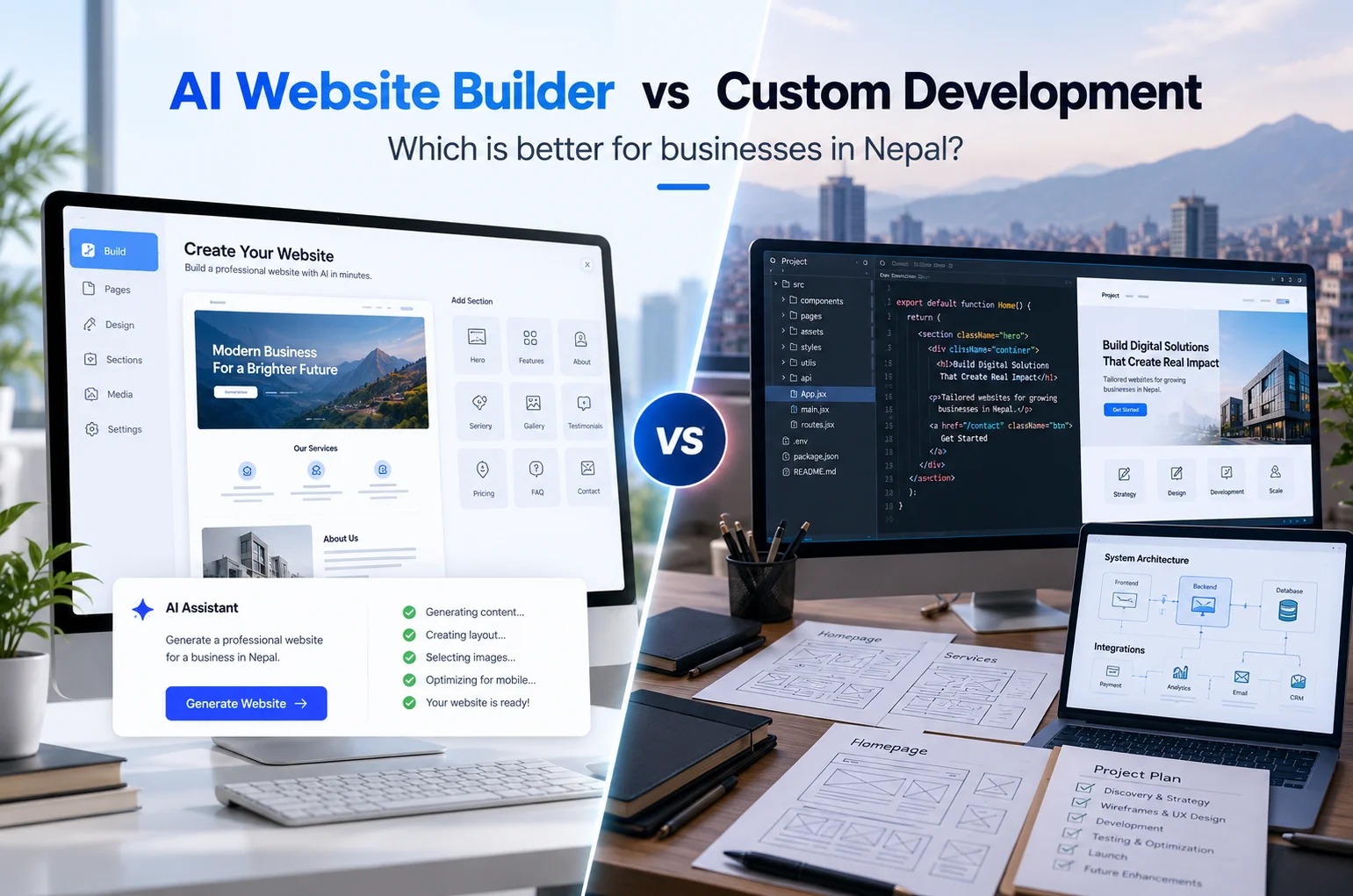
AI can now create a basic website in minutes. Enter your business name, describe what you do, choose a style, and an AI website builder can generate pages, text, images, layouts, and contact forms with surprisingly little effort.
That sounds attractive, especially for a startup or small business trying to reduce costs.
But getting a website online and building a website that supports a real business are not always the same thing.
For some businesses in Nepal, an AI website builder may be perfectly adequate. For others, particularly companies that depend on search traffic, enquiries, ecommerce, integrations, custom functionality, or future expansion, professional website development can offer much more flexibility.
The right decision depends on what the website needs to accomplish.
This guide compares AI website builders vs custom website development across cost, speed, design, SEO, performance, ownership, integrations, security, scalability, and long-term business value.
What Is an AI Website Builder?
An AI website builder is a platform that uses artificial intelligence to help create websites with minimal manual design or development work.
Instead of starting with an empty page, you usually answer questions about your business, industry, preferred style, and required pages.
The platform may then generate:
- A homepage layout
- Service pages
- About and contact pages
- Written content
- Images
- Colour combinations
- Navigation
- Forms
- Calls to action
- Basic SEO settings
Tools from companies such as Wix, Squarespace, Hostinger, and other website platforms increasingly include AI-assisted website creation.
You can then edit the generated website through a visual editor rather than writing code.
That makes AI builders particularly attractive to people who want to create something quickly without hiring a designer or developer.
What Is Custom Website Development?
Custom website development starts with the needs of the business rather than the limitations of a predefined website generator.
A web design and development team in Nepal typically considers the following factors:
- Your business goals
- Customers and target market
- Website structure
- User journeys
- Branding
- Content
- Required functionality
- Search visibility
- Mobile experience
- Integrations
- Security
- Future expansion
The website may be developed using platforms such as WordPress or WooCommerce, or frameworks and technologies such as Laravel, React, Next.js, Node.js, or a custom content management system.
“Custom” does not always mean every line of code has to be created from scratch.
It means the solution is selected and configured around the requirements of the project instead of forcing the business into a fixed website template.
AI Website Builder vs Custom Website Development: Quick Comparison
| Factor | AI Website Builder | Custom Website Development |
|---|---|---|
| Initial cost | Usually lower | Usually higher |
| Setup speed | Very fast | Takes more planning and development |
| Technical knowledge | Little required | Development handled by professionals |
| Design flexibility | Limited by the platform | Much greater flexibility |
| Unique branding | Moderate | High |
| Custom functionality | Limited to supported features | Can be built around business needs |
| SEO control | Suitable for basic SEO | Greater technical and structural control |
| Integrations | Platform dependent | Much more flexible |
| Scalability | Can become restrictive | Can be planned for growth |
| Maintenance | Mostly platform managed | Depends on the technology and support plan |
| Ownership/control | Platform dependent | Usually greater control |
| Best for | Simple sites and testing ideas | Businesses with long-term digital goals |
Neither option wins every category.
The question is which limitations you are willing to accept.
Where AI Website Builders Work Well
AI website builders have improved considerably.
They can be a sensible choice when your requirements are straightforward.
1. You Need a Website Quickly
If you need a simple online presence for an event, temporary project, personal portfolio, or newly tested business idea, speed may matter more than advanced functionality.
An AI builder can create a usable starting point much faster than a traditional design and development process.
2. Your Budget Is Very Limited
A new business may not be ready to invest in a professionally developed website.
Using an AI builder can provide a low-cost way to establish an initial online presence while the business validates its idea.
3. Your Website Is Simple
Suppose your website only needs:
- Home
- About
- Services
- Contact
- A basic enquiry form
An AI builder may handle those requirements reasonably well.
There is little benefit in overengineering a website that genuinely only needs a few straightforward pages.
4. You Want to Manage Everything Yourself
Many AI website platforms are designed for nontechnical users.
Changing text, replacing photos, creating a new page, or updating contact details can often be done visually.
For owners who want complete day-to-day control without depending on a developer for small changes, that simplicity can be useful.
Where AI Website Builders Start to Become Restrictive
The limitations usually become clearer when the website has to do more than present basic information.
Customisation Is Limited by the Platform
An AI builder may generate a polished design, but you are still working inside the system provided by that platform.
You can change many things, but not necessarily everything.
If your business later needs an unusual customer journey, custom database, specialised booking process, quotation system, customer portal, or integration, you may discover that the builder cannot support it cleanly.
Your Website Can Look Generic
AI tools create designs using established layout patterns because those patterns work across many industries.
That is convenient, but it can also make websites look similar.
For businesses competing on reputation, trust, premium positioning, or brand identity, a recognisable design may be more important than simply having an attractive template.
Integrations Can Become Difficult
Businesses rarely operate using only a website.
A growing company may need to connect the site with:
- Customer relationship management software
- Accounting systems
- Booking software
- Inventory systems
- Email marketing tools
- Payment gateways
- Internal business applications
- APIs
- Customer databases
Some AI builders provide integrations through apps or plugins.
The problem appears when the integration you need is not supported or does not work in the way your business operates.
Custom development provides more options for connecting systems where suitable APIs or technical access are available.
Why Custom Website Development Makes Sense for Growing Businesses
Custom development costs more because more planning, design, technical work, testing, and quality control are involved.
But businesses are not paying only for more code.
They are paying for greater control over how the website supports the business.
1. The Website Can Be Planned Around Your Customers
A professional website project usually starts before visual design.
For example, imagine a trekking company in Nepal.
Visitors may arrive looking for:
- Trek packages
- Difficulty levels
- Best travel seasons
- Itineraries
- Prices
- Accommodation details
- Permits
- Enquiries
- Custom trips
A generic template might simply list all services.
A properly planned website can organise this information around how travellers actually compare and choose trekking packages.
The difference is not just visual.
It changes how easily a potential customer can make a decision.
2. You Get Greater Design Freedom
A custom website can reflect the personality and positioning of the company rather than adapting the company to a theme.
Designers can make decisions around:
- Typography
- Brand colours
- Page hierarchy
- Interactive elements
- Mobile layouts
- Visual storytelling
- Calls to action
- Forms
- Navigation
- Content presentation
This matters most where the website contributes directly to perceived credibility.
Banks, healthcare organisations, educational institutions, hotels, professional service firms, manufacturers, NGOs, and established companies often need more control over how their brand appears online.
3. Custom Functionality Can Support Real Business Processes
This is often the strongest reason to move beyond an AI website builder.
A website may need to:
- Generate quotations
- Accept bookings
- Process applications
- Sell products
- Manage members
- Provide customer accounts
- Search large databases
- Display property listings
- Connect to inventory
- Publish large volumes of content
- Support multiple branches
- Handle subscriptions
- Integrate payment systems
- Connect with internal software
At that point, the website is becoming part of the company’s operational infrastructure.
Building around those requirements normally makes more sense than continuously adding workarounds to a limited platform.
What About SEO? Does Google Prefer Custom Websites?
No.
Google does not rank a website simply because it was custom coded, nor does it automatically penalise a website because AI helped create it.
Google says its systems focus on whether content is useful, original, reliable, accurate, and created primarily to help people. Using generative AI by itself does not provide a ranking advantage or disadvantage.
The same principle applies to websites.
A poorly planned custom website can perform badly in search.
A well-built website created through a website builder can perform well.
What matters is what the final site provides.
For SEO, important factors include:
- Crawlable pages
- Logical website architecture
- Useful content
- Clear titles and headings
- Internal linking
- Mobile usability
- Page performance
- Image optimisation
- Structured data where relevant
- Correct canonicalisation
- Indexability
- Helpful user experience
Google’s current guidance for generative AI experiences also continues to emphasise foundational SEO and unique, useful, noncommodity content rather than special “AI optimisation” tricks.
So the real SEO question is not:
Was this website created with AI?
It is:
Does the platform give you enough control to build and maintain a strong website?
AI Generated Content Still Needs Human Review
One area where AI website builders require particular attention is content.
An AI tool can quickly produce:
- Service descriptions
- Headlines
- FAQs
- Calls to action
- About page copy
That can save time.
But publishing generated content without checking it can create problems.
AI generated text may be:
- Too generic
- Similar to competitor content
- Incorrect
- Overconfident
- Repetitive
- Poorly matched to your customers
- Missing important local context
- Filled with claims the business cannot support
Google specifically recommends focusing on accuracy, quality, relevance, and original value when using generative AI for content.
AI can help with the process.
It should not replace knowledge of your own business.
What About AI Search, AEO and GEO?
Businesses are increasingly thinking beyond traditional Google results.
People now use AI-powered search and assistants to research products, services, companies, and questions.
This has led to terms such as AEO, or Answer Engine Optimization, and GEO, or Generative Engine Optimization.
You may see claims that a particular website technology automatically makes a business more visible to AI systems.
That is too simplistic.
Google’s 2026 guidance on generative AI search says the foundations remain familiar: create technically accessible websites and publish useful, original content that provides real value.
Clear information can help search and AI systems understand:
- What your company does
- Where you operate
- Which services you provide
- Who those services are for
- Why your company is credible
- How customers can contact you
A custom website can give you more freedom to structure this information properly, but simply having a custom website does not guarantee visibility.
Content quality and business credibility still matter.
Which Option Gives You Better Website Performance?
There is no universal winner.
Some hosted website builders have highly optimised infrastructure.
Some custom websites are extremely fast.
Others are slow because they contain oversized images, unnecessary scripts, poorly configured plugins, excessive tracking tools, or inefficient code.
Performance depends on implementation.
Custom development can provide greater control over:
- Code
- Hosting
- Caching
- Image delivery
- Scripts
- Databases
- Third-party resources
But that control is only valuable when used properly.
When comparing options, ask developers or platform providers how they handle performance rather than assuming that one technology is automatically faster.
What About Website Ownership?
This is an important issue that businesses sometimes overlook.
With many hosted website builders, the website operates inside the provider’s ecosystem.
You may own your domain, content, branding, and uploaded materials, but moving the exact website to another platform may not be simple.
If you later decide to leave, you might have to rebuild parts or all of the site elsewhere.
A custom website can often provide greater portability and technical control, particularly when it is built using widely supported technologies and the client receives appropriate access.
Before starting any website project, clarify:
- Who owns the domain?
- Who controls hosting?
- Who controls the CMS?
- Who has administrator access?
- Can the website be migrated?
- Who owns custom code and design files?
- Are there proprietary dependencies?
- What happens if you change providers?
These questions matter regardless of whether you use AI or a web development company.
AI Website Builder vs Custom Development Cost in Nepal
AI builders usually win on initial price.
You may only need to pay a monthly or annual platform subscription, depending on the service and plan.
Custom development requires a larger upfront investment because it involves human planning, design, development, testing, and project management.
For some local context, Webtech Nepal’s published 2026 pricing currently lists starter websites from NPR 25,000 to NPR 60,000, while its business website packages are listed from NPR 75,000 to NPR 150,000. More advanced ecommerce and custom development can cost significantly more depending on requirements.
Prices can change, so these figures should be checked before budgeting.
The cheapest option is not necessarily the least expensive over several years.
Consider the total cost of:
- Platform subscriptions
- Premium plugins or applications
- Transaction fees
- Developer assistance
- Hosting
- Maintenance
- Redesigns
- Integrations
- SEO work
- Rebuilding the site if you outgrow the platform
If you expect to replace an inexpensive website after twelve months because it cannot support the business, the initial saving may disappear.
On the other hand, paying for a large custom solution when your business only needs five simple pages is unnecessary.
Match the investment to the problem.
When Should You Choose an AI Website Builder?
An AI website builder can be a sensible choice when:
- You are testing a new business idea.
- You need a simple website immediately.
- Your budget is very limited.
- You only need a few informational pages.
- You do not require specialised integrations.
- Your website is not central to your sales process.
- You are comfortable working within platform limitations.
- You expect the site to remain relatively simple.
For example, a freelance consultant who mainly receives referrals and only needs a short profile, list of services, and contact form may not require custom development initially.
When Should You Choose Custom Website Development?
Custom development becomes more worthwhile when:
- Your website generates leads or sales.
- Search visibility is important to customer acquisition.
- You need custom workflows or functionality.
- You have a strong or established brand.
- You need integrations with other software.
- Your site contains large amounts of content.
- You operate an ecommerce business.
- You expect traffic, products, locations, or services to grow.
- You need greater technical control.
- Your website is part of a larger digital platform.
A large educational institution, ecommerce company, travel business, corporate organisation, news portal, financial service provider, or multi-location business will usually have very different requirements from a one-person startup.
Their websites should not necessarily be built the same way.
Is a Hybrid Approach Better?
Often, yes.
AI website builder vs custom development does not need to be an all-or-nothing argument.
Professional development teams increasingly use AI too.
AI can assist with:
- Early wireframe ideas
- Content planning
- Coding assistance
- Image concepts
- Quality checks
- Content organisation
- Research
- Testing
- Documentation
The difference is that AI becomes a tool within a professional process rather than the process itself.
A developer can use automation to save time while still making deliberate decisions about architecture, design, security, integrations, performance, content, and usability.
For many businesses, this is likely to become the normal approach.
Questions to Ask Before Choosing Either Option
Before deciding how to build your website, answer these questions.
What Should the Website Achieve?
Do you simply need credibility when someone searches your company name?
Or should the website generate enquiries, bookings, applications, subscriptions, or ecommerce sales?
The more responsibility you give the website, the more carefully it should be planned.
What Will You Need in Two Years?
Avoid planning only for launch day.
Think about whether you may later add:
- New locations
- More languages
- Ecommerce
- Customer accounts
- Online payments
- A mobile application
- CRM integration
- Hundreds of products
- Large content libraries
You do not need to build every future feature today.
But you should avoid choosing a platform that makes predictable growth unnecessarily difficult.
How Important Is Organic Search?
If SEO is expected to become a major acquisition channel, check how much control the platform provides over technical SEO, page structure, redirects, metadata, internal linking, structured data, indexing, and content expansion.
Who Will Maintain the Website?
A custom website that nobody can update is not useful.
An AI website that is easy to edit but impossible to extend may create a different problem.
Choose a system that fits both your technical requirements and the people responsible for managing it.
What Happens If You Want to Leave?
Ask this before signing up, not after.
Your website should not become a business dependency you cannot easily control.
Common Mistakes Businesses Make When Choosing a Website Platform
Choosing Only on Price
Price matters, but website requirements should come first.
A cheap solution that cannot perform an essential function is not cheap.
Buying More Technology Than You Need
The opposite problem is equally common.
A small business does not need an enterprise development stack simply because it sounds impressive.
Use the simplest solution that comfortably supports your current and reasonably expected future needs.
Assuming AI Automatically Means Better
AI can speed up website creation.
It cannot automatically understand your market, customers, competitive positioning, internal workflow, or business strategy.
Those still require human decisions.
Assuming Custom Development Automatically Means Better
Custom websites can also fail.
Poor planning, weak design, slow development, bad SEO implementation, unnecessary features, and difficult administration can make a custom project worse than a good website builder.
Evaluate the people and process, not just the technology.
How Webtech Nepal Approaches Website Development
Webtech Nepal develops business websites, ecommerce stores, WordPress websites, web applications, mobile apps, and other digital platforms for organisations in Nepal and international clients.
Our current website development process begins with understanding the business, audience, content, requirements, and goals before moving into website structure, UI design, development, optimisation, testing, and launch.
Depending on the project, our team works with technologies including WordPress, WooCommerce, Laravel, React, Next.js, Node.js, and other appropriate tools.
That means the recommendation does not have to be the same for every client.
A startup that needs a simple website should not receive the same technical solution as an ecommerce company, large publication, or organisation requiring custom software integration.
The platform should fit the business.
Frequently Asked Questions
Is an AI website builder good for a small business in Nepal?
Yes, if the website is simple and the business mainly needs a basic online presence. It can be an economical way to test an idea before investing in a larger website. Businesses expecting ecommerce, advanced SEO, integrations, or significant growth should examine platform limitations carefully.
Can an AI website rank on Google?
Yes. Google does not automatically reject websites or content because AI was involved in creating them. The final website still needs useful content, sound technical SEO, good user experience, and information that genuinely helps visitors.
Is custom website development better for SEO?
Custom development provides more control, which can make advanced SEO implementation easier. However, custom coding alone does not improve rankings. Content quality, technical implementation, authority, relevance, and user experience still matter.
How much does custom website development cost in Nepal?
Costs vary significantly depending on design, features, integrations, content, technology, and project size. Webtech Nepal currently publishes starter website packages from NPR 25,000 to NPR 60,000 and business website packages from NPR 75,000 to NPR 150,000. More complex ecommerce sites and applications require custom estimates.
Can I start with an AI website and move to a custom website later?
Yes, but migration difficulty depends on the platform. Content, images, products, and data may sometimes be transferable, while the design and functionality may need to be rebuilt. Check export and migration options before choosing a platform.
Does Webtech Nepal use AI in website development?
AI can be useful as part of modern design, content, research, and development workflows, but technology should support rather than replace project planning, professional design, development, testing, and human judgment. The most suitable workflow depends on the project.
Conclusion
Choosing between an AI website builder and custom website development comes down to what role the website plays in your business.
If you need a simple online presence, want to test an idea, or have a very limited budget, an AI website builder may be enough.
If the website needs to generate business, support complex functionality, integrate with other systems, strengthen a distinctive brand, grow with the company, or provide greater technical control, custom website development is usually worth considering.
Do not choose custom development simply because it sounds more professional. And do not choose an AI builder simply because it is faster.
Start with the business requirements.
If you are unsure which approach suits your project, Webtech Nepal can review your website goals, required features, future plans, and budget and recommend an appropriate development approach.