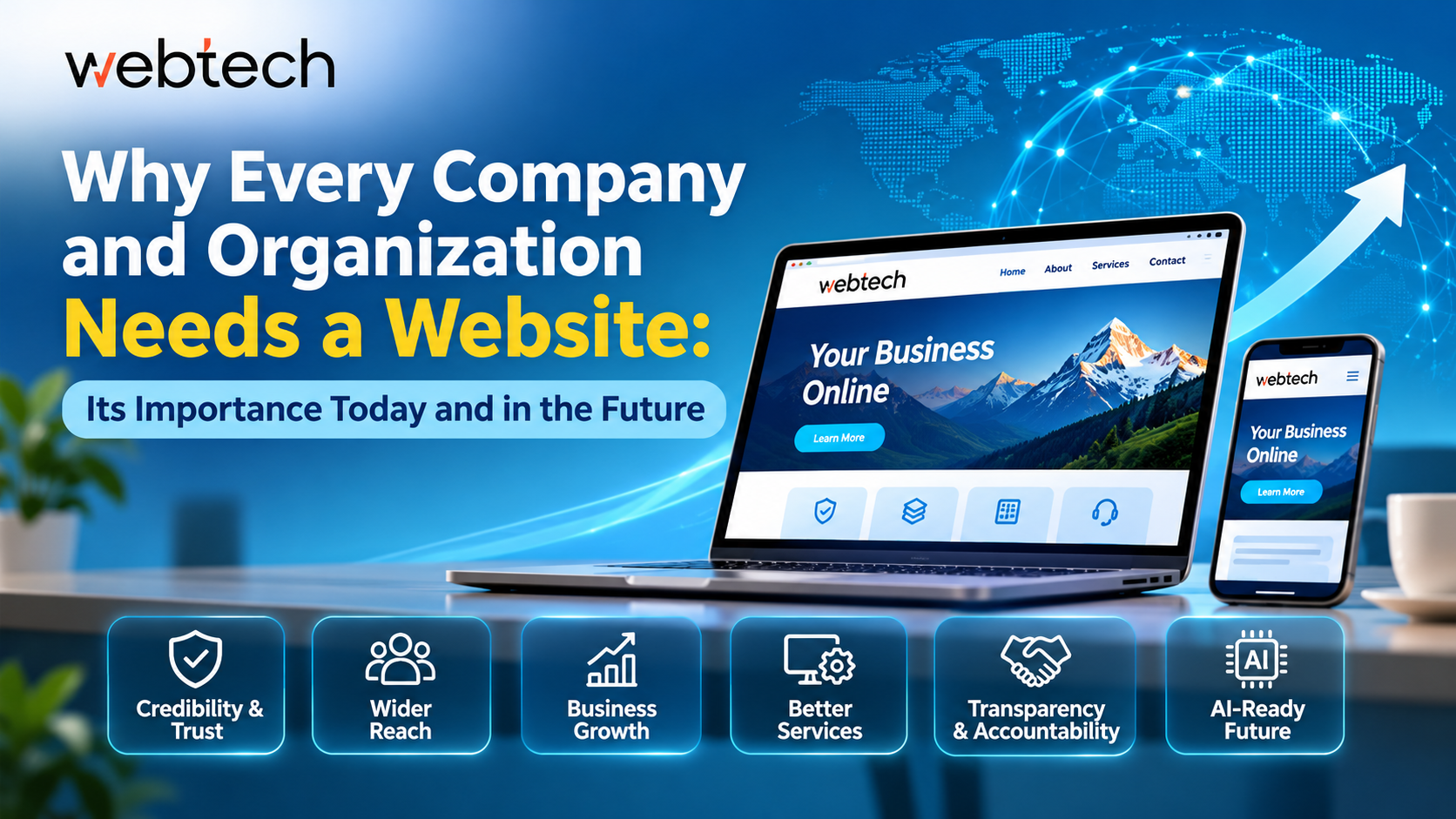
From digital identity and public trust to economic growth, artificial intelligence, and international competitiveness — why a professional website is becoming essential infrastructure for every organization.
The world is moving rapidly toward a digital-first society. How people discover businesses, verify organizations, access services, communicate, and make decisions has fundamentally changed. A company may have a physical office, a registration certificate, a telephone number, and a social media presence, but without an official website, an important part of its identity remains missing in the digital world.
A website is no longer simply an online brochure or an optional marketing tool. It has become an organization’s official digital address, a source of verified information, a communication platform, and a foundation for future digital services.
For developing economies such as Nepal, the importance goes even further. Widespread adoption of professional websites and official domain names can support business transparency, digital literacy, entrepreneurship, international trade, and the country’s overall digital transformation.
- A website is the official digital identity of an organization
Every legally registered company or organization has a name, an address, and a recognized identity. In today’s connected world, it increasingly needs an equally recognizable digital identity.
A domain name such as company.com.np or company.com provides a permanent and recognizable online address through which customers, suppliers, government institutions, and international partners can identify the organization.
Consider two companies offering similar services. One has only a social media page and a mobile number. The other maintains an official website containing its registration information, management details, products, services, physical address, contact information, and professional email addresses.
The second company provides more opportunities for independent verification. This does not automatically make it trustworthy, but it helps customers and partners evaluate its legitimacy.
A website allows an organization to establish a consistent identity that it controls, rather than depending entirely on a third-party platform.
- Why social media cannot replace an official website
Facebook, Instagram, TikTok, LinkedIn, and other social platforms are valuable communication and marketing channels. They help organizations reach audiences, publish updates, and build communities.
However, these platforms are owned and controlled by other companies. Their policies, algorithms, account restrictions, and commercial models can change.
A social media account may be suspended, compromised, or lose visibility. An organization also has limited control over how its information is organized and presented.
An official website provides a more stable foundation for its digital presence.
| Official website | Social media |
| Organization controls its domain and content | Platform controls the account environment |
| Structured and searchable information | Primarily feed-based information |
| Supports customized services and integrations | Limited to platform capabilities |
| Supports domain-based professional email | Primarily platform messaging |
| Can serve as a long-term information archive | Content visibility depends on platform rules |
The most effective approach is not to choose between websites and social media. It is to use social media for outreach while keeping the official website as the primary source of authoritative organizational information.
- Building credibility, transparency, and public trust
Trust is one of the most important assets of any business or institution.
Before purchasing a product, entering a partnership, donating to an organization, applying for a job, or signing a contract, people often search online to verify the organization.
A professional website can provide information such as:
- Legal name, registration details, and physical address.
- Products, services, organizational objectives, and activities.
- Management, leadership, and official contact information.
- Policies, reports, publications, and announcements.
- Customer support, complaints, and feedback channels.
For nonprofit organizations, professional associations, educational institutions, and public bodies, a website can also support accountability by making reports, decisions, notices, and institutional activities accessible to the public.
Importantly, a website is a tool for transparency, not proof of legitimacy by itself. Accurate information, responsible governance, secure systems, and regular updates are what turn a website into a trusted source.
- Websites support business growth and international competitiveness
The internet has reduced many geographical barriers to business.
A small trekking agency in Nepal can reach travelers in Europe. A handicraft producer in Kathmandu can attract buyers in Japan. A software company can demonstrate its services to clients in Australia or the United States without opening an office in those countries.
A professional website makes these opportunities more accessible by enabling businesses to present information internationally, accept inquiries, publish catalogs, receive bookings, and integrate digital payments.
For Nepal, this is particularly important in tourism, information technology, education, agriculture, manufacturing, handicrafts, and export-oriented services.
A well-designed website with multilingual content, search-engine visibility, secure communication, and reliable contact information can help even a small enterprise participate in international markets.
- A website is becoming an operational platform, not just an information page
The role of websites has expanded significantly.
Modern websites can integrate customer relationship management, online payments, appointment scheduling, e-commerce, recruitment, document management, service requests, and customer support.
A hotel website can manage direct reservations. An educational institution can accept applications. A professional association can manage membership renewals. A government office can publish notices and offer online services.
This reduces dependence on manual procedures and can improve accessibility, efficiency, and recordkeeping.
The website therefore becomes an entry point to an organization’s wider digital infrastructure.
- The global digital economy makes websites increasingly important
Global internet users, 2025
6 billion
Approximately three-quarters of the global population
People still offline globally
2.2 billion
Digital inclusion remains a major challenge
Source: International Telecommunication Union, Facts and Figures 2025.
These figures demonstrate the scale of the digital environment in which organizations now operate. They also remind us that digital development must be inclusive.
A company without a website may still operate successfully through personal relationships, physical locations, or social networks. But it risks missing opportunities among customers, institutions, and partners who expect reliable information to be accessible online.
For internationally active organizations, a professional website is increasingly a basic element of commercial readiness.
- Nepal’s digital transformation: Why websites deserve national attention
Nepal has made progress in internet connectivity, digital payments, information technology services, and public-sector digitization. However, business-level digital adoption remains uneven.
A World Bank economic memorandum published in 2025 reported that only 52% of firms in the underlying assessment had websites. This suggests that a substantial proportion of businesses still lack their own web presence, although the figure should not be interpreted as a complete census of every registered Nepali enterprise.
World Bank
Website adoption among firms in Nepal
52% with websites
48% without websites
World Bank, Nepal Country Economic Memorandum, 2025. Figures refer to the firms covered by the underlying assessment.
Nepal’s wider digital transformation ambitions make this issue especially relevant.
In February 2026, the World Bank approved US$50 million in financing for the Nepal Digital Transformation Project, supporting digital public infrastructure, online citizen services, electronic signatures, cybersecurity, and data governance.
World Bank
These investments demonstrate that digital transformation is no longer limited to the telecommunications or IT sectors. It increasingly concerns the entire economy and the delivery of public services.
For Nepal, greater adoption of official websites could contribute to:
- Improved visibility of registered businesses and organizations.
- Easier access to accurate institutional information.
- Increased opportunities for domestic and international commerce.
- Better communication between citizens, businesses, and government.
- Stronger foundations for digital payments and online service delivery.
- More opportunities for Nepali technology companies, developers, and digital professionals.
- Should every registered company and organization have an official domain and website?
This is an important policy question for Nepal.
Currently, company registration and domain registration are generally separate processes. A company can be legally established without operating a website.
However, as Nepal advances its digital transformation agenda, policymakers could consider introducing a national framework encouraging every registered organization to maintain a verifiable digital identity.
Such a framework might begin with domain registration and a basic public information page rather than requiring every business to invest in a complex website.
For example, a small enterprise could maintain a simple website displaying its legal name, registration number, business activities, location, and official contact details.
Larger organizations could operate more comprehensive websites with financial disclosures, service platforms, reporting systems, and customer support.
The objective should not be to create an unnecessary financial or technical burden. It should be to establish a practical minimum standard for digital identification and public access to organizational information.
A possible phased approach for Nepal
| Phase | Proposed approach |
| Phase 1 | Encourage every registered business to reserve an official domain |
| Phase 2 | Provide affordable website packages and digital literacy support |
| Phase 3 | Establish a minimum public-information standard for larger companies and regulated organizations |
| Phase 4 | Integrate voluntary, verified business identity with government digital services |
| Phase 5 | Evaluate mandatory requirements for selected sectors, with exemptions and assistance for small enterprises |
Any mandatory framework would require an appropriate legal basis, consultation, privacy safeguards, affordable access, and clear implementation responsibilities.
Importantly, owning a domain does not automatically establish legal identity. A trustworthy national system would need to connect domain ownership with verified registration records while protecting personal information.
- The future: Websites in the age of artificial intelligence
Artificial intelligence is changing how people discover and interact with information.
Traditional internet searching has relied heavily on users entering keywords and browsing lists of websites. Increasingly, AI-powered systems can summarize information, compare services, and help users make decisions through conversational interfaces.
This transformation creates a new reason for organizations to maintain reliable official websites.
AI systems may draw information from websites, structured databases, search indexes, and other digital sources. Organizations that publish accurate, well-organized, machine-readable information are better positioned to make their services discoverable.
A website with clear descriptions, structured data, updated contact information, accessible content, and technically reliable pages can support both human visitors and automated information systems.
Nevertheless, publishing information online does not guarantee that an AI system will find, cite, or accurately represent it.
In the coming years, websites are likely to become increasingly connected with AI assistants, automated customer support, intelligent search, multilingual services, and business management systems.
The website of the future may function not merely as a collection of pages but as a digital gateway through which people and software systems interact with an organization.
- Cybersecurity, accessibility, and digital responsibility
As websites become more important, organizations must also take greater responsibility for their security, reliability, and accessibility.
A poorly maintained website can expose users to misinformation, fraudulent content, malware, or data breaches. A professional digital presence therefore requires more than attractive design.
Organizations should invest in secure hosting, HTTPS, regular software updates, backups, access controls, and appropriate privacy practices.
Accessibility is equally important. Websites should be usable by people with different abilities, devices, and connectivity conditions.
The World Wide Web Consortium’s Web Content Accessibility Guidelines (WCAG) 2.2 provide an internationally recognized standard for improving digital accessibility.
W3C
For Nepal, where internet access and digital literacy vary significantly between urban and rural communities, websites should also be mobile-friendly, efficient on slower connections, and available in appropriate local languages.
Digital transformation must not leave people behind.
- The role of government, private sector, and professional organizations
A national culture of digital presence cannot be created by legislation alone.
Government institutions can establish appropriate standards and support digital identity infrastructure. Chambers of commerce and professional associations can promote awareness among their members. Educational institutions can strengthen digital skills.
Meanwhile, technology companies can develop affordable, secure, and accessible website solutions suited to the needs of small and medium enterprises.
The domain-registration, hosting, cybersecurity, software-development, and digital-marketing industries also have an important role to play.
Collaboration between these stakeholders could make digital adoption more practical and sustainable.
For Nepal, the opportunity is not simply to increase the number of registered domains. It is to create a stronger, more trustworthy, and more productive digital economy.
- Looking ahead: The next decade of organizational identity
Over the next decade, organizations are likely to become more dependent on interconnected digital services.
Official websites may increasingly serve as gateways to verified organizational identities, electronic transactions, digital credentials, AI-assisted services, and automated interactions between institutions.
International customers and partners will continue to expect accessible, reliable, and verifiable information.
For developing countries, building this foundation early can support economic participation and international competitiveness.
The organizations that benefit most will not necessarily be those with the most expensive websites. They will be those that maintain useful, trustworthy, accessible, and continuously updated digital services.
Conclusion: A website is becoming a necessity, not a luxury
A company registration certificate establishes a business’s legal existence. A physical office provides a place to operate. A telephone number enables communication.
An official website extends that identity into the digital world, where customers, partners, institutions, and increasingly intelligent technologies expect to find reliable information.
For companies, websites support credibility, market access, communication, and business growth. For nonprofit organizations, they promote visibility and accountability. For public institutions, they can improve transparency and service delivery.
For Nepal, encouraging every registered organization to establish a meaningful digital presence could be an important step toward building a more connected and internationally competitive economy.
The long-term national objective should be broader than simply making domain names compulsory. It should be to ensure that every organization has an affordable, secure, accessible, and verifiable digital identity.
A website alone cannot guarantee success. But in an increasingly digital world, operating without one can limit an organization’s visibility, opportunities, and readiness for the future.
The question is no longer simply whether an organization needs a website. It is how effectively that organization can use its digital presence to serve people, build trust, and prepare for tomorrow.
Research references: ITU Facts and Figures 2025 · World Bank — Nepal Digital Transformation Project · W3C Web Accessibility Guidelines · World Bank — Nepal Country Economic Memorandum