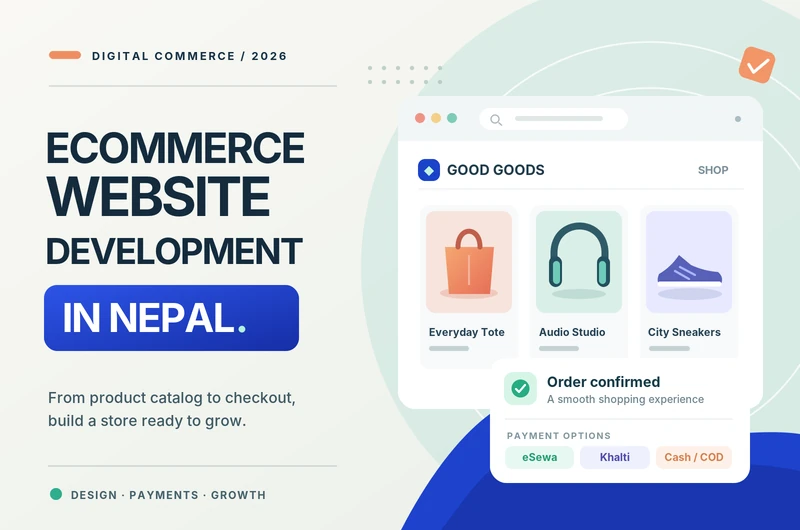
If you are ready for ecommerce website development in Nepal, start with four things in this order: a clean product catalog, a working cart and checkout, local payment options your customers already use, and secure hosting with daily backups. Get those right and everything else, from design polish to marketing, becomes far easier to add later.
Plenty of Nepali businesses sell well without any of this. They just lose orders in the process. Picture a small clothing brand in Kathmandu taking orders through Instagram DMs. A customer asks for a price, waits two hours for a reply, asks about sizes, waits again, then a second customer messages about the same item that already sold. Payments arrive as blurry eSewa screenshots. Nobody is quite sure what is in stock. The sales are real, but the chaos caps how much the business can grow.
An ecommerce website fixes that by doing the repetitive work for you. This guide walks through where to begin, what every online shop in Nepal actually needs, and how to decide between a ready-made platform and a custom build.
What Core Features Does Every Nepali Online Shop Need?
Four features form the foundation of any store: a product catalog, a shopping cart, a secure checkout, and inventory tracking. Everything else is an add-on. According to the Baymard Institute, the average documented online shopping cart abandonment rate is 70.22% across 50 studies (Baymard Institute, 2025). A clear catalog and a short checkout are your best defence against that drop-off.
Start with the catalog. Each product needs good photos, an honest description, a price, and variant options like size or colour. Group products into categories a shopper can browse without thinking.
The cart holds items while a customer keeps shopping. The checkout then collects the delivery address and payment. Keep it short. Every extra field is another reason to abandon the order.
Inventory tracking ties it together. When the last unit of a shirt sells, the site should mark it out of stock automatically. That single feature ends the awkward message telling a customer the item they just paid for is gone.
A quick way to compare your options:
| Need | Template platform | Custom build |
|---|---|---|
| Simple catalog, few products | Strong fit | Overkill |
| Standard cart and checkout | Works well | Works well |
| Unusual workflows or integrations | Limited | Strong fit |
| Full control over speed and design | Limited | Strong fit |
Webtech Nepal builds this foundation for local businesses without templates or outsourcing, so the catalog, checkout, and stock logic fit how your shop actually works.
How Should a Nepali Store Handle Local Payments?
Give shoppers the payment methods they already trust: eSewa, Khalti, Fonepay QR, bank transfer, and cash on delivery. Digital wallets in Nepal are no longer a niche. Wallets such as eSewa and Khalti handled payments worth Rs 53.01 billion in a single month, while QR code payments reached 59.26 million transactions worth Rs 162.58 billion in the same period (Kathmandu Post, 2026).
That scale tells you something practical. A checkout that only accepts a card will quietly turn away a large share of buyers. The same report notes that mobile banking transactions reached NPR 612.39 billion in a month, so your customers are already comfortable paying from their phones.
Here is what a Nepal-ready checkout looks like:
- Digital wallets: eSewa and Khalti for one-tap mobile payments.
- QR payments: Fonepay QR, which many shoppers now scan by habit.
- Bank transfer: useful for larger orders and business buyers.
- Cash on delivery: still the comfort option for first-time customers who want to see the product before paying.
Cash on delivery deserves a note. It raises the risk of returns and failed deliveries, so pair it with order confirmation by phone and a clear return policy. Offering it alongside wallets, rather than instead of them, gives nervous first-time buyers a way in.
Why Does Secure Hosting, SSL, and Backups Matter So Much?
Security is where trust is won or lost, because an online store holds customer names, addresses, and payment details. SSL is the baseline. It encrypts the data travelling between your shop and your customer, and browsers now flag any store without it as “Not Secure.” Free certificates from Let’s Encrypt, a nonprofit certificate authority, enable HTTPS for any website (Let’s Encrypt, 2026), so there is no excuse to skip it.
Hosting matters just as much. A store hosted on a slow, oversold server loads sluggishly and drops offline during your busiest sales. Managed hosting takes that worry off your plate: the provider handles updates, server security, and uptime so you can focus on selling.
Then there are backups, the part everyone ignores until the day they need it. Imagine a plugin update breaks your checkout, or a server fault wipes your product data during Dashain sales. Without a recent backup, you are rebuilding from memory. With daily automated backups and a tested restore process, you are back online in minutes.
A safe setup for a Nepali store comes down to a short checklist:
- SSL certificate installed and auto-renewing, so HTTPS never lapses.
- Managed hosting with regular security patching and monitoring.
- Daily backups stored off the main server, with restores tested now and then.
- A .com.np or .com domain registered in your own name, not your developer’s.
Webtech Nepal provides managed hosting, backups, disaster recovery, and security monitoring under one roof, which keeps these pieces from falling through the cracks between separate vendors.
Ecommerce Website Development in Nepal: Template or Custom Build?
Choose a template platform for a straightforward catalog, and move to custom development when your needs outgrow what a template can bend to do. Most first stores in Nepal start well on a solid platform like WordPress with WooCommerce. It is quick to launch, affordable, and covers the standard catalog-cart-checkout path.
Templates start to strain in specific situations. You feel it when:
- Your checkout needs an unusual flow, such as wholesale pricing tiers or custom product configurators.
- You need tight integration with accounting software, a delivery partner’s API, or an existing inventory system.
- Traffic is high enough that page speed and server load become real constraints.
- You want full control over design and performance rather than fitting your idea into a theme.

A custom build costs more upfront and takes longer, so it earns its place only when a template genuinely holds you back. The honest answer for many Nepali businesses is to start lean on a platform, prove the model, then invest in custom work once the orders justify it. A good development partner will tell you which stage you are at instead of selling you the most expensive option.
That judgement is where a local partner helps. Webtech Nepal builds both template-based and fully custom stores, so the recommendation is based on your product count, workflows, and growth plans rather than on a fixed package.
Turning Instagram Orders Into a Real Store
The clothing brand from the start of this guide does not need to replace Instagram. It needs a website doing the heavy lifting behind it, with a catalog that shows live stock, a checkout that takes eSewa and cash on delivery, and hosting that stays up during a sale. The DMs then become a marketing channel pointing to a store that handles orders on its own.
The sensible next step is a short conversation about your specific shop: how many products you sell, which payments your customers use, and where orders slip through today. Webtech Nepal offers a free ecommerce consultation to map that out and give you a straight recommendation on platform, payments, and hosting. Request a free quote when you are ready to turn scattered orders into a store that runs itself.
Frequently asked questions
How much does ecommerce website development in Nepal cost?
Costs vary widely by scope. A small template-based store with a handful of products sits at the low end, while a custom-built shop with inventory sync, multiple payment gateways, and heavy traffic costs more. Request a quote based on your product count and features.
Which payment gateways should a Nepali online store support?
Offer eSewa, Khalti, and Fonepay QR for digital payments, plus bank transfer and cash on delivery. Nepali shoppers expect choice, and cash on delivery still builds trust with first-time buyers.
Do I need SSL for my ecommerce website?
Yes. SSL encrypts the data moving between your shop and your customers, including payment details. Free certificates from Let’s Encrypt enable HTTPS, and most browsers now warn visitors away from stores without it.
Should I use a template or build a custom ecommerce site?
Start with a well-built platform if your catalog is simple. Move to custom development when you need unusual checkout flows, tight integrations with accounting or delivery partners, or performance at scale that templates struggle to deliver.