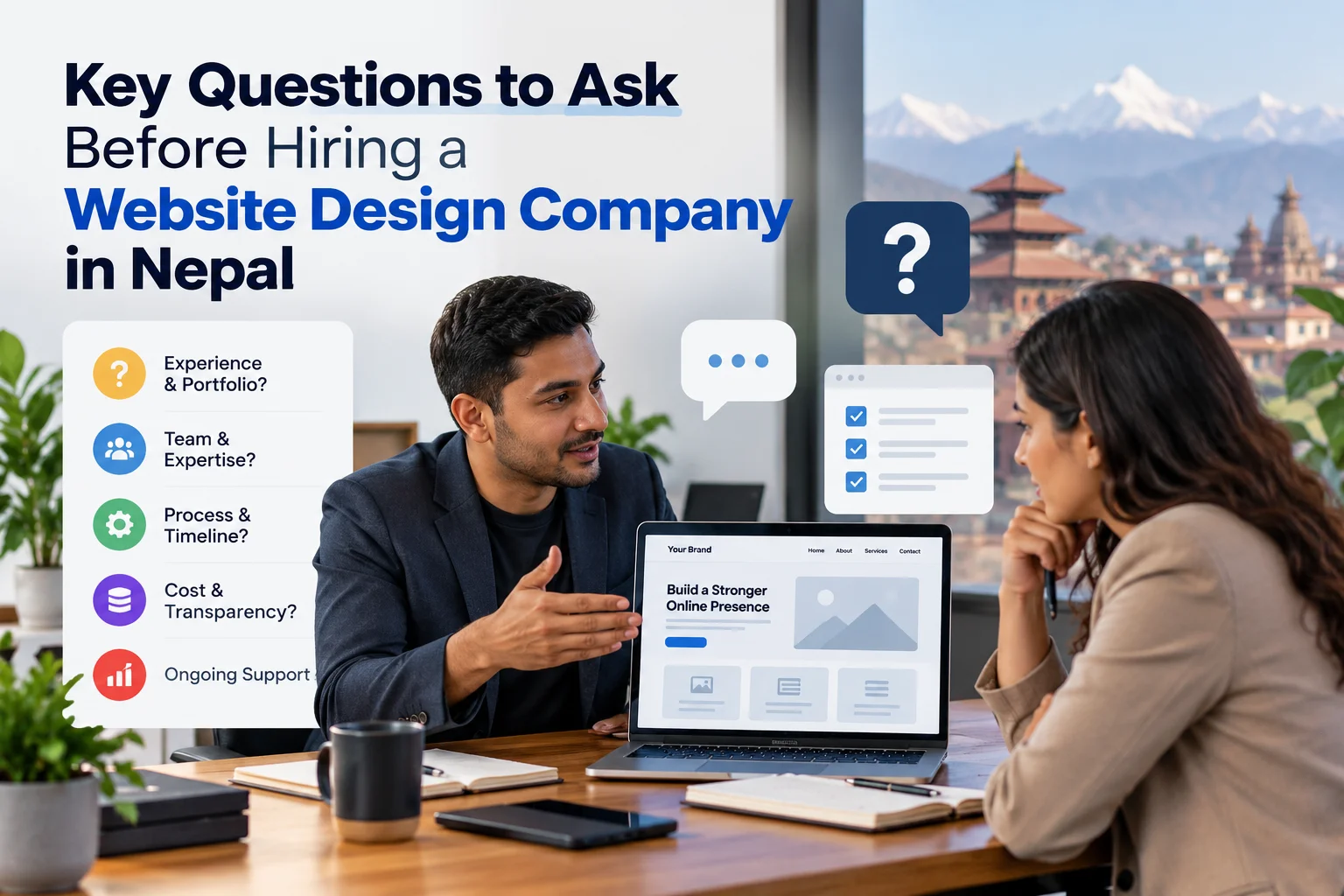
Many buyers choose a website design company in Nepal based on one thing: the cheapest quote they can find. It’s an understandable instinct, but it often leads to predictable trouble, a site that loads slowly, an agency that stops responding after launch, and a business that Google can’t find. That pattern tends to repeat itself, and it’s largely avoidable if you know what to ask before you sign anything.
We’ve spent years building websites across tourism, healthcare, SaaS, and ecommerce for clients ranging from Nepali startups to established enterprises. The pattern we see repeatedly is that businesses that ask better questions upfront spend less money fixing problems later. This guide gives you a practical set of questions and a hiring checklist designed to filter out the wrong agencies fast, so you can shortlist the right ones with confidence.
1. Does their portfolio actually match your type of project?
The first filter most buyers skip is industry fit. A portfolio full of restaurant websites tells you nothing about whether an agency can build a booking-driven trekking platform or a WooCommerce store with inventory management. Visual polish is easy to fake with a premium theme. What matters is whether the agency has delivered comparable functionality to what you actually need.
How to read a portfolio beyond aesthetics
Ask for a live URL for a project similar to yours, not a screenshot or a Behance mockup. Load it on your phone. Fill out a form. Click through the navigation. A site that looks good in a screenshot can be completely broken in practice. What you want to verify is functional evidence: inquiry forms for tourism companies, product catalogs with payment integrations for ecommerce, role-based dashboards for SaaS products.
The evaluation framework that works: prioritize business and audience similarity first, then functionality and conversion evidence, then live technical quality, and visual style last. An agency with beautiful but unrelated work has not demonstrated that it can solve your industry’s specific problems.
Industry-specific examples to look for
Different sectors have very different technical requirements. Tourism and trekking companies need SEO-friendly, inquiry-driven sites with multilingual support. Ecommerce businesses need secure checkout and eSewa/Khalti integrations, along with reliable inventory management. SaaS products require scalable architecture and admin panels that non-technical team members can actually use. When reviewing a portfolio, check that the agency has delivered at least one project with requirements close to yours, not just something in a broadly similar industry.
The case study test
Ask for one specific case study that details the problem, the scope, and a measurable result. A strong case study explains the client’s challenge, the design decisions made, and what changed after launch.
If they can’t produce one, that’s your answer.
2. Hiring a Website Design Company in Nepal: What to Ask About Pricing
Vague quotes are a red flag. Any reputable web development company in Nepal should be able to give you a price range upfront based on your page count, features, and CMS requirements. Agencies that hedge on price before the project starts will hedge on scope during it.
2026 market rates by project type
Based on quotes and published rate data across the Nepal web market, a basic company website with 5 to 15 pages typically runs NPR 25,000 to NPR 150,000. A professionally designed corporate site with CMS and basic SEO commonly lands between NPR 100,000 and NPR 200,000.
Ecommerce websites with payment integration run NPR 80,000 to NPR 500,000 or more, depending on inventory complexity and integrations. Custom web applications, including booking systems, dashboards, and SaaS products, typically start at NPR 150,000 and can reach NPR 1,500,000 or beyond for multi-role enterprise platforms.
What a quote often leaves out
Many agencies quote only the build cost. Hosting, SSL certificates, premium plugins, payment gateway fees, content entry, and post-launch maintenance are frequently billed separately. Domain registration adds roughly NPR 1,000 to NPR 3,000 per year, and shared hosting adds NPR 2,000 to NPR 8,000 annually based on Nepal market rates. Ask the agency to itemize all first-year costs in writing before you agree to anything.
Why pricing transparency is non-negotiable
If a company won’t give you a written cost breakdown before you sign, don’t sign.
3. What technology stack are they building on, and does it include SEO and security?
A well-designed site that loads slowly, ranks nowhere, and gets compromised three months in is a liability, not an asset. The technology questions matter as much as the design questions, and you don’t need to be technical to ask them.
Technology questions every client should ask
Ask which CMS or framework the agency uses and why. WordPress, Laravel, Next.js, and custom builds each carry different implications for editing ease, scalability, and ongoing costs. Ask whether the site will be built mobile-first, how Core Web Vitals performance is handled, and whether they use a staging environment before pushing changes live. An agency that can’t answer those questions clearly is not the right partner for your project.
On-site SEO and security basics that should come standard
A reputable digital agency in Nepal should include page titles, meta descriptions, image alt text, clean URL structures, SSL, and basic malware protection as default deliverables, not as add-ons. If an agency quotes basic on-page SEO as a separate line item, push back. Server-side rendering for key pages, HTTPS configuration, secure headers, and automated backups should all be part of the standard build process in 2026.
The Microsoft Partner advantage
We hold Microsoft Partner status, which signals adherence to verified technical standards. That credential becomes relevant when evaluating agencies for cloud hosting, Azure integrations, or enterprise-grade security requirements. When you’re comparing agencies, third-party technical recognition is one of the few signals that isn’t self-reported.
4. Who handles your site after it goes live?
Post-launch support is where many web design companies in Nepal struggle to deliver consistently. Ask this question in the first call, not after the contract is signed. The answer tells you more about an agency’s operational maturity than almost anything else.
What a proper maintenance retainer actually covers
Nepal market rates for maintenance retainers generally fall into three tiers. Basic plans run approximately NPR 3,000 to NPR 6,000 per month and cover updates, backups, monitoring, and minor edits. Standard plans run approximately NPR 6,000 to NPR 12,000 per month and add content updates and performance optimization. Premium plans run approximately NPR 12,000 to NPR 25,000 per month and include priority support, monthly reporting, and limited feature work.
Ask whether the retainer includes a monthly hours limit, defined response times, emergency fees, and what happens to your site if you cancel.
Managed hosting inclusions to verify
Not all hosting packages are equal. Confirm whether the agency’s hosting includes SSL, automated daily backups, uptime monitoring, malware scanning, CDN, and a migration guarantee if you ever switch providers. That level of published detail is what you should expect from any website design company in Nepal you seriously consider.
The ownership question
Ask directly: if you cancel the retainer, do you keep full access to the hosting account, domain, source code, and Google Analytics? The answer should always be yes. Any agency that ties your asset access to a continued billing relationship is not acting in your interest.
5. How do you verify that an agency delivers what it promises?
Any web design company in Nepal can claim they’re the best. Third-party platforms give you the actual receipts, and knowing how to read them saves you from making expensive decisions based on self-reported marketing.
Where to check independent reviews
Clutch, The Manifest, DesignRush, and TechBehemoths are well-regarded sources for verified Nepal web agency reviews. Read them critically: a 5.0 rating from three reviews is much weaker evidence than a 4.8 from thirteen. Look at review dates, project descriptions, and whether reviewers describe the agency’s communication, delivery reliability, and post-launch behavior by name. Clutch in particular reduces the influence of reviews older than two years, so recency matters alongside volume.
What industry recognition signals
Third-party recognition on platforms like DesignRush and TechBehemoths means an agency has been vetted against documented criteria, not just self-nominated. When comparing agencies, look for the combination of review volume, recency, and third-party recognition rather than any single signal.
Red flags to act on immediately
Remove any agency from your shortlist that has no third-party reviews, a portfolio of dead links, no published maintenance terms, and a refusal to share client references. These are not minor omissions. Always ask for two recent client references and actually call them. Ask those references specifically about what happened after launch, not just whether they liked the design.
6. Your practical hiring checklist: questions, contract items, and next steps
This checklist consolidates everything above into the exact steps to take before you sign anything.
Five questions to ask in the first call
Start with portfolio fit: ask for comparable industry examples with live URLs you can test yourself. Then ask for a full first-year cost breakdown that includes hosting, maintenance, and any third-party fees. Ask which technology stack and CMS they use, and whether you’ll be able to edit content yourself after handover. Ask specifically about post-launch support terms: what’s included, what the response time commitment is, and what the emergency process looks like. Finally, confirm ownership of all assets outright, your domain, source code, hosting account, and Google Analytics access must belong to you at contract end, regardless of what happens to the relationship.
Three contract items to confirm before signing
First, require a written milestone and payment schedule tied to deliverables rather than just calendar dates. Second, confirm a clause specifying asset ownership and data portability on cancellation. Third, get defined revision rounds in writing, along with a clear process for handling requests that fall outside the agreed scope. Agencies that resist any of these items are telling you something worth listening to before you pay a deposit.
Your next step
If you want a second set of eyes on your current site or a clear proposal for a new one, get in touch with our team at Webtech Nepal. We work across tourism, ecommerce, healthcare, and SaaS, tell us what you’re building and we’ll take it from there.
The bottom line on hiring the right website design company in Nepal
Choosing the right website design company in Nepal comes down to asking better questions, not chasing the lowest price. A portfolio without case studies is a warning sign. So is a quote with no maintenance terms attached. So is an agency with no third-party verification. Each of those gaps shows up clearly when you know what to look for, and this checklist gives you exactly that.
Working through these questions is likely to help you shortlist faster and avoid costly mistakes that are difficult to undo after a contract is signed. At Webtech Nepal, we check every box covered in this article: a publicly visible portfolio spanning multiple industries, transparent pricing, managed hosting with documented terms, Microsoft Partner credentials, and verified listings on DesignRush and TechBehemoths. If you’re ready to take the next step, reach out and tell us what you’re building.