You’ve decided your business needs professional web development and a website that actually works for you. Now you’re buried under quotes from freelancers on Facebook, polished pitch decks from agencies, and firms promising to handle everything from strategy to server maintenance. Quotes can vary widely, sometimes by a factor of three to five. The promises all sound identical. It’s exhausting, and it honestly feels that way by design.
Having worked with Nepali business owners across industries, including many that Webtech Nepal has partnered with directly over the past several years, a few patterns keep repeating. The businesses that get the best results aren’t necessarily the ones with the biggest budgets. They’re the ones who understood what they were actually buying before they signed anything, an observation that holds true across project types and budget levels. This article gives you that clarity.
What modern web development actually covers for your business
Website development today is far more than a few pages with your phone number and a contact form. Nepali businesses generally fall into one of these categories: a custom business website for service companies and professional firms; a web application for booking systems, portals, and role-based dashboards; or a full e-commerce store with product catalogs, payment gateway integration, and inventory management. The category you fall into shapes everything, who you hire, what you pay, and what the finished product needs to do.
One distinction worth understanding upfront: website design and web development are related but different disciplines. Design is how your site looks and feels, layouts, colors, navigation, and the overall user experience. Development is how it actually works, covering the HTML, CSS, and JavaScript on the front end, plus the server logic, database, and security layer on the back end. A partner worth hiring delivers both as a unified result, not two separate handoffs.
Beyond that, four things are non-negotiable for any Nepal-focused business competing online. Speed matters because slow pages lose visitors, especially users on mobile data networks. Security matters because SSL certificates, data protection, and secure payment handling are baseline expectations, not upgrades. SEO matters because your site needs to be found by the right people on Google, not just look good once someone already has the URL. And mobile-first design matters because a large and growing share of Nepali users browse on smartphones rather than desktop computers, a trend that shows no sign of reversing.
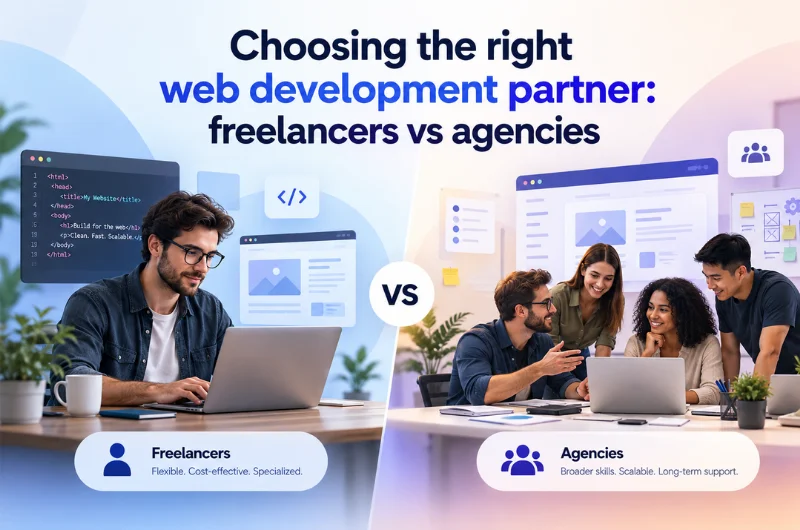
The honest difference between freelancers, agencies, and full-service firms
Freelancers are often skilled and genuinely affordable for small, well-defined projects. A single developer can build a clean website quickly and at a lower cost than a full team. The limitation is scope: many freelancers focus on a single area, front-end development or back-end development, and covering both at a consistently high level is less common. They typically don’t offer managed hosting, and many move on after launch. If something breaks six months later, or a plugin update crashes your site, you’re largely on your own.
A web agency typically assigns a team: a designer, a developer, and a project manager. That structure raises the quality ceiling for larger projects. But agencies vary significantly in how they handle post-launch responsibilities. Many hand you a finished site and close the project. If your hosting goes down or your site gets hacked, you start a new conversation, often with a new quote attached.
A full-service firm goes further. It handles everything from strategy and design through website development, hosting, security updates, SEO, and ongoing support, all under one roof. For a Nepali SME or tourism operator without an in-house technical team, this continuity is worth more than most businesses realize when they’re comparing upfront quotes. The relationship doesn’t end at launch; it continues as your business grows and your site needs to grow with it.
How to scope your project before you talk to anyone
Start with what the site needs to do
Before you request a single quote, nail down what you want the website to accomplish, who your primary audience is, and which features are non-negotiable versus which are nice-to-have. A tourism company targeting European trekkers needs multilingual content, fast image loading, and a functional inquiry form more than it needs an elaborate homepage animation. Knowing your priorities upfront stops you from overpaying for features you don’t need and under-specifying the ones that actually drive business.
Technology choices should match your business stage, not your partner’s preferred web development stack. A small business website is usually well-served by WordPress or a modern CMS, this keeps costs manageable and makes content updates straightforward. E-commerce projects often use WooCommerce or a custom-built solution depending on scale, with local payment gateways like eSewa and Khalti integrated from the start. Web apps and booking platforms require custom development using modern full-stack frameworks and a database that can handle real transactions reliably.
Build the foundations in from day one
Regardless of project type, mobile-first design, fast and reliable hosting, and an SEO-ready site structure should be built into the project from the beginning, not treated as features you add in a later phase that may never arrive. Retrofitting them after a site is live consistently costs more, in time and money, than building them correctly from the start.
What web development costs in Nepal: realistic pricing expectations
These 2026 price ranges for the Nepali market give you a useful benchmark before conversations begin. A professional small-business website runs approximately NPR 40,000 to 100,000, covering custom design, a CMS, lead forms, and basic SEO setup. A travel or trekking agency website with tour pages, galleries, inquiry forms, and multilingual content typically runs NPR 60,000 to 150,000. E-commerce stores with payment integration start higher and scale based on product volume and custom features. Advanced booking platforms with live availability and customer accounts can exceed NPR 300,000 to 500,000.
Very low quotes almost always point to the same underlying problems: template work with minimal customization, no SEO foundation built into the site structure, or no post-launch support included in the price. The cheapest option and the most expensive option are rarely the right answer. The right answer is transparent, itemized pricing from a firm that can explain what each line item includes.
Budget an additional NPR 11,500 to 46,000 per year for domain renewal, hosting, security updates, backups, and maintenance, depending on your site’s complexity and traffic. These costs catch many businesses off guard after launch. A partner offering managed hosting and maintenance bundles these expenses predictably, removing the anxiety of unexpected bills and ensuring your site stays secure and current without you having to manage it manually.
What professional website development delivered for a Nepali trekking company
Consider this representative scenario: a Nepali trekking and tourism operator whose website loaded in over six seconds on mobile, had no SSL certificate, no functional booking inquiry form, and ranked on page four of Google for its own company name. Inquiries came almost entirely through word of mouth. International visitors planning treks simply couldn’t find the business online, and those who did land on the site often left before scrolling past the first section.
After partnering with a full-service firm for a custom website rebuild, page load time dropped to under two seconds. Organic search traffic grew by over 200% within six months, driven by proper site structure, optimized content, and technical SEO foundations built into the project from day one. Inquiry volume from international visitors grew by more than 50%, turning a word-of-mouth operation into one with a functioning digital channel. These figures reflect agency-reported outcomes from the project; specific analytics data is available on request.
That outcome wasn’t accidental. It came from a team that treated speed, SEO, security, and mobile performance as foundational requirements, not features slated for a second phase that never happened. The difference between a site that generates inquiries and one that just exists online almost always comes down to decisions made during the build.
What to look for in a web development partner: credentials and continuity
Not all web development companies are equal, and credentials give you a practical way to separate firms with real capability from those with a well-designed sales deck. Look for companies listed on independent platforms like DesignRush or TechBehemoths, where clients leave reviews through third-party verification processes rather than testimonials the company drafted for itself. Look for technology partnerships that require demonstrated technical competency, for example, Microsoft’s Solutions Partner designations, which involve meeting capability scores, active certifications, and customer evidence requirements that go beyond basic enrollment. Look for a portfolio with outcomes described in business terms, not just screenshots of finished designs.
Webtech Nepal holds Microsoft Partner recognition, is listed and reviewed on both DesignRush and TechBehemoths with client feedback, and operates with transparent, itemized pricing so clients understand exactly what they’re paying for before any work begins. Managed hosting is included as a core offering, not an add-on, which means your site stays online, secure, and updated without you needing to source a new vendor every time something needs attention. The team works across industries: startups, SMEs, tourism and trekking operators, educational institutions, and SaaS businesses. That breadth of real delivery experience shows up in how projects are scoped and executed.
Post-launch support is built into the relationship by design, not bolted on as an afterthought. In practice, that means regular security updates, performance monitoring, and a point of contact when something needs attention, rather than starting a new project negotiation every time an issue arises. That distinction matters more than almost anything else when you’re evaluating who to trust with your business’s primary digital presence.
Making the right call for your business
Your website is your storefront, your sales representative, and your credibility signal, often the first thing a potential customer sees before deciding whether to reach out. The partner who builds it shapes how well it performs those functions, and for how long. Choosing the wrong partner doesn’t just mean a website you’re not proud of; it means recurring technical problems, hidden costs, and a site that isn’t growing your business the way it should.
Freelancers are the right choice for small, contained projects with a clearly defined scope and a client who has the time and capability to manage their own hosting and updates afterward. Agencies work well when you need a team and already have some internal technical oversight to coordinate with them. A full-service firm with proven credentials, transparent pricing, and genuine ongoing support is the right choice for most Nepali SMEs and tourism operators who want their web development handled properly without adding technical project management to their workload.
If you’re ready to talk through your specific project, Webtech Nepal is straightforward about what your site will need, what it will cost, and what results are realistic for your situation. Tell us what you’re building and we’ll give you an honest assessment, no commitment required.