Nepal is known around the world for its mountains, trekking routes, cultural heritage, wildlife, and adventure travel. From Everest Base Camp and Annapurna to city tours, jungle safaris, rafting, and cultural trips, Nepal offers many experiences for travelers.
But travelers do not usually contact a travel company after seeing only a name or phone number. They first search online, compare tour packages, check prices, view photos, read reviews, and look for a simple way to make an inquiry or booking.
That makes a professional website an important part of a travel and trekking business.
Travel and trekking website design in Nepal should do more than display tour information. It should help visitors discover trips, understand what is included, build trust, and contact or book your company with ease.
At Webtech Nepal, we create travel and trekking websites designed around these goals. A well-planned website can help tour operators, trekking agencies, travel companies, adventure operators, and destination management companies build a stronger online presence and generate more inquiries.
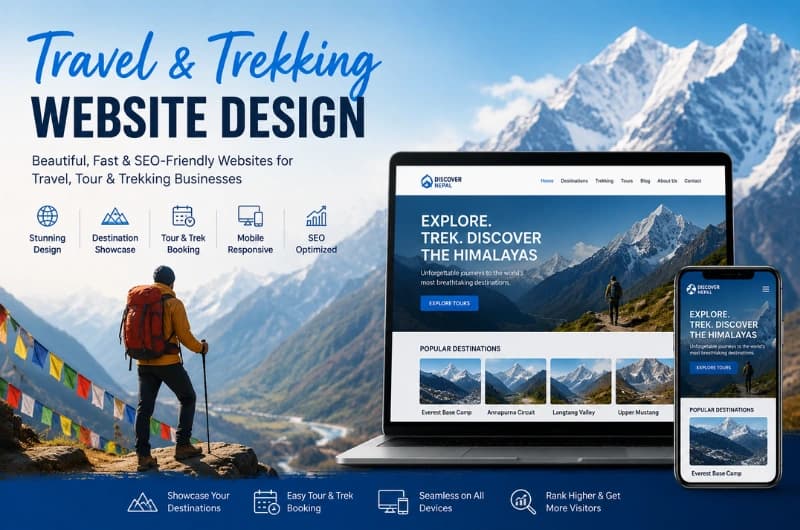
Suggested image: Featured image showing a modern Nepal trekking website on a laptop and smartphone, with Mount Everest, trekking trails, and tour package cards.
What Is Travel & Trekking Website Design?
Travel and trekking website design is the process of creating a website specifically for businesses that sell travel, trekking, tours, adventure activities, holidays, and related services.
Unlike a basic business website, a travel website often needs to manage a large amount of information. Visitors may need to see:
- Trekking routes
- Tour packages
- Destinations
- Itineraries
- Prices
- Trip duration
- Difficulty levels
- Departure dates
- Accommodation details
- Transportation information
- Included and excluded services
- Travel requirements
- Frequently asked questions
- Booking and inquiry options
The website must organize this information clearly while also using attractive images to inspire travelers.
A successful travel website design in Nepal combines attractive visuals, simple navigation, useful content, mobile-friendly design, search engine optimization, and easy booking or inquiry features.
Why Travel and Trekking Companies in Nepal Need a Professional Website
A professional website can become one of the most useful sales and marketing tools for a travel company.
Travelers from Nepal and other countries can find your services at any time. They can explore your packages before contacting your team.
1. Build Trust Before the First Contact
Travelers want to know whether a company is genuine and reliable before paying for a trip.
Your website can help build trust by showing:
- Company information
- Registration details where appropriate
- Experienced guides
- Office information
- Customer reviews
- Trip photos
- Safety information
- Clear terms and conditions
- Contact details
- Frequently asked questions
A clean website gives visitors confidence that they are dealing with a professional travel company.
2. Promote Your Trekking Packages 24/7
Your office may close at the end of the day, but your website does not.
Visitors can check your trekking packages, itineraries, prices, and contact information at any time.
This is especially useful for international travelers who may be searching from different time zones.
3. Reach International Travelers
Nepal attracts visitors from many countries. A search-friendly website allows your company to reach people who are already looking for trekking and travel services.
For example, someone searching for:
- Everest Base Camp trekking company
- Annapurna trekking package
- Nepal trekking agency
- Nepal tour packages
- Kathmandu tour package
- Best trekking agency in Nepal
- Luxury Nepal tour
- Nepal adventure travel
may discover your website through Google or other search engines.
4. Generate More Direct Inquiries
A website can encourage visitors to contact you directly instead of relying only on social media or third-party travel platforms.
You can add:
- Inquiry forms
- WhatsApp buttons
- Phone numbers
- Email forms
- Booking forms
- Request-a-quote buttons
- Live chat
- Social media links
These features make it easier for visitors to take the next step.
Essential Features of a Travel & Trekking Website
A good travel website should be designed around the needs of travelers.
Here are some of the most useful features.
1. Attractive Homepage
The homepage creates the first impression of your company.
It should quickly tell visitors:
- Who you are
- What you offer
- Where you operate
- Why travelers should choose you
- How they can contact you
A strong homepage can include a large destination image, featured trekking packages, popular tours, company benefits, customer reviews, and a clear call to action.
2. Tour and Trekking Package Pages
Every major tour or trekking package should have its own dedicated page.
A package page can include:
- Trip name
- Duration
- Destination
- Difficulty
- Maximum altitude
- Best season
- Price
- Detailed itinerary
- Included services
- Excluded services
- Accommodation
- Transportation
- Guide information
- Gallery
- FAQs
- Booking or inquiry button
Dedicated pages also create more opportunities to rank for specific search terms.
3. Online Booking and Inquiry System
A booking or inquiry system can make the process easier for both travelers and staff.
Visitors can submit information such as:
- Name
- Country
- Phone number
- Preferred travel date
- Number of travelers
- Selected trip
- Special requirements
- Questions or comments
The website can then send the inquiry directly to your team.
4. Trekking Itinerary
Trekking customers often want to know exactly what each day looks like.
An easy-to-read itinerary can show:
Day 01: Arrival in Kathmandu Day 02: Kathmandu sightseeing Day 03: Flight to Lukla and trek to Phakding Day 04: Trek to Namche Bazaar
You can add distance, walking hours, altitude, accommodation, and meals where relevant.
5. Trek Difficulty Information
Not every trek is suitable for every traveler.
Your website should explain difficulty levels in simple language.
For example:
| Level | Suitable For |
|---|---|
| Easy | Most travelers with basic fitness |
| Moderate | Travelers with regular walking experience |
| Challenging | Experienced hikers with good fitness |
| Difficult | Experienced trekkers prepared for demanding conditions |
This helps visitors choose a trip that matches their abilities.
6. Destination Pages
Create dedicated pages for important destinations.
Examples include:
- Everest Region
- Annapurna Region
- Langtang Region
- Manaslu Region
- Kathmandu
- Pokhara
- Chitwan
- Lumbini
- Mustang
Each destination page can explain attractions, activities, travel seasons, transportation, and available packages.
7. Photo and Video Gallery
Travel is highly visual.
High-quality photographs can help visitors understand what they can expect from a trip.
A gallery can show:
- Mountains
- Trekking trails
- Villages
- Hotels
- Guides
- Landscapes
- Cultural experiences
- Wildlife
- Previous travelers
Videos can also show trekking routes, destinations, guides, and customer experiences.
Suggested image: Screenshot-style visual showing a travel website gallery with trekking, mountain, culture, and adventure photos.
8. Customer Reviews and Testimonials
Reviews can help reduce doubts before a traveler makes a booking.
Display genuine reviews from previous customers whenever possible.
You can include:
- Customer name
- Country
- Trip name
- Review
- Date
- Photo, if permission is available
Do not publish fake reviews. Trust is especially important for travel businesses.
9. Blog and Travel Guide
A travel blog can attract people who are still researching their trip.
Useful topics include:
- Best time to trek in Nepal
- Everest Base Camp packing guide
- Annapurna Circuit trekking guide
- What to expect on a Nepal trek
- Nepal visa information
- Trekking permits in Nepal
- Travel tips for first-time visitors
- Best places to visit in Nepal
- Nepal trekking costs
- Kathmandu travel guide
Blog content can bring organic traffic and link visitors to your relevant tour packages.
10. Contact and Location Information
Your contact page should be easy to find.
Include:
- Office address
- Phone number
- Email address
- Business hours
- Google Maps location
- Inquiry form
- Social media profiles
For a Nepal-based company, showing your local office location can also help visitors feel more confident.
Mobile-Friendly Travel Website Design
Many travelers search for trips using smartphones.
Your website should work well on:
- Mobile phones
- Tablets
- Laptops
- Desktop computers
A mobile-friendly website should have readable text, large buttons, simple menus, fast-loading images, and forms that are easy to complete on a small screen.
This is also important for search visibility because search engines consider mobile usability when evaluating websites.
SEO for Travel and Trekking Websites in Nepal
A beautiful website will not help much if travelers cannot find it.
Search engine optimization, or SEO, helps your website appear when people search for your services.
A travel website can target keywords such as:
- Travel agency in Nepal
- Trekking agency in Nepal
- Trekking company in Nepal
- Nepal trekking packages
- Nepal tour packages
- Everest Base Camp trek
- Annapurna trekking
- Nepal adventure tours
- Travel company in Kathmandu
- Trekking agency in Kathmandu
Do not place these keywords everywhere. Each page should focus on a clear topic and answer the visitor’s questions.
Local SEO
Local SEO is useful for travel companies serving customers from Kathmandu and other parts of Nepal.
Your website should clearly mention relevant business information, including your company name, address, phone number, and service areas.
A properly managed Google Business Profile can also help your company appear in local search results.
Website Speed Matters for Travel Businesses
Travel websites often contain many large photographs. If these images are not optimized, the website can become slow.
Slow pages can frustrate visitors, especially those using mobile networks.
Good website development should include:
- Image compression
- Modern image formats where suitable
- Browser caching
- Optimized code
- Fast hosting
- Reduced unnecessary scripts
- Mobile performance testing
The goal is simple: visitors should be able to open your pages quickly and start exploring your trips.
Secure Website Development for Travel Agencies
Travel websites may collect personal information through inquiry and booking forms.
Security should therefore be part of the development process.
Important measures can include:
- SSL/HTTPS
- Secure forms
- Strong administrator passwords
- Regular website updates
- Reliable backups
- Secure hosting
- Spam protection
- Access control
If online payments are added, payment processing should use a trusted payment provider and follow the provider’s security requirements.
Travel Website Content Management System
A content management system, such as WordPress, can make it easier for travel companies to update their websites.
Your team can manage:
- Tour packages
- Prices
- Itineraries
- Blog posts
- Photos
- Destinations
- FAQs
- Testimonials
- Contact information
This means you do not need to contact a developer every time you want to make a simple content update.
For larger travel companies, a custom website or custom booking system may be more suitable depending on business requirements.
Online Payment Integration
Some travel businesses may want to accept online payments or deposits.
Depending on the target market and available payment services, a website may support suitable local or international payment options.
Before adding payment functionality, consider:
- Currency
- Customer location
- Payment provider availability
- Transaction fees
- Refund policies
- Security
- Business requirements
The payment process should be simple and clearly explain what the customer is paying for.
Multi-Language Travel Websites
If your company targets travelers from different countries, a multilingual website can be useful.
For example, the website may offer English plus other languages based on your target audience.
However, translations should be accurate and natural. Poor machine translation can make a professional travel company look less trustworthy.
How Webtech Nepal Can Help With Travel & Trekking Website Development
Webtech Nepal can help travel and trekking companies build professional websites based on their services and target customers.
The development process can include:
Step 1: Understand Your Business
First, we learn about your company, destinations, packages, customers, and business goals.
Step 2: Plan the Website Structure
We organize the pages and content so visitors can find important information easily.
A typical structure may include:
Home → Destinations → Trekking Packages → Tour Packages → About Us → Gallery → Blog → FAQs → Contact
Step 3: Design the User Interface
The design is created to match your travel brand while keeping the interface simple and easy to use.
Step 4: Develop the Website
The approved design is converted into a working website with the required features.
Step 5: Add Travel Content
Tour packages, itineraries, photographs, destination information, reviews, and other content are added to the website.
Step 6: Optimize for Search Engines
Important pages are structured with SEO in mind, including page titles, headings, URLs, internal links, image alt text, and relevant content.
Step 7: Test Before Launch
The website should be tested on different screen sizes and browsers.
Forms, buttons, menus, links, booking features, and other important functions should also be checked.
Step 8: Launch and Support
After testing, the website can be published. Ongoing maintenance, security updates, backups, and content changes can be handled as needed.
Travel Website Design vs. Basic Business Website
A travel and trekking website needs more than a simple company profile.
| Feature | Basic Business Website | Travel & Trekking Website |
|---|---|---|
| Company information | Yes | Yes |
| Service pages | Yes | Yes |
| Tour packages | Limited | Essential |
| Detailed itineraries | No/limited | Essential |
| Destination pages | No/limited | Recommended |
| Booking forms | Optional | Recommended |
| Trek difficulty | No | Useful |
| Photo gallery | Optional | Important |
| Customer reviews | Optional | Recommended |
| Travel blog | Optional | Highly useful |
| Payment integration | Optional | Depends on business |
| SEO landing pages | Basic | Important |
The right website depends on your business model. A small trekking agency may not need a complex booking engine, while a larger tour operator may benefit from advanced booking and payment features.
Common Mistakes to Avoid
Even a visually attractive travel website can perform poorly if it has usability problems.
Avoid these common mistakes:
Using Too Many Large Images
Beautiful images are useful, but unoptimized images can slow down your website.
Hiding Prices
If your packages have fixed prices, displaying them clearly can help customers make decisions faster.
If prices change based on group size, season, or services, explain how the final price is calculated.
Making the Booking Process Complicated
Do not ask visitors to complete a long form when only a few details are needed for the first inquiry.
Ignoring Mobile Users
A website that works well only on desktop computers can lose potential customers.
Publishing Outdated Information
Travel information can change. Keep prices, itineraries, permits, transportation details, contact information, and other important content updated.
Using Fake Reviews
Fake testimonials may damage your reputation. Use genuine customer feedback instead.
Forgetting SEO
A website needs useful, searchable content if you want to attract organic traffic.
Recommended Website Structure for a Trekking Agency
A professional trekking agency website can use a structure like this:
- Home
- About Us
- Trekking
- Everest Region
- Annapurna Region
- Langtang Region
- Manaslu Region
- Tour Packages
- Adventure Activities
- Destinations
- Gallery
- Travel Information
- Blog
- FAQs
- Contact Us
This structure can be changed based on the company’s services.
Key Benefits of Professional Travel Website Development
A well-designed travel website can help your business:
- Build a professional brand
- Reach travelers through search engines
- Showcase trekking and tour packages
- Generate direct inquiries
- Provide information 24/7
- Build customer trust
- Promote new destinations
- Collect booking requests
- Reduce repetitive customer questions
- Support digital marketing campaigns
- Improve the customer experience
The website should not simply look good. It should help visitors move from research → trust → inquiry → booking.
Frequently Asked Questions
How much does travel and trekking website design cost in Nepal?
The cost depends on the website size, number of packages, booking features, payment integration, custom design, content requirements, and other technical features. A simple agency website costs less than a website with advanced booking and payment systems.
What should a trekking agency website include?
A trekking agency website should normally include trekking packages, itineraries, destinations, prices, difficulty levels, galleries, customer reviews, FAQs, inquiry forms, contact details, and useful travel information.
Can I accept bookings through my travel website?
Yes. A website can include booking forms, reservation systems, and, where suitable, online payment integration. The best approach depends on how your travel business manages bookings.
Is WordPress good for a trekking website?
Yes. WordPress can be a practical option for many trekking and travel companies because it makes it easier to manage tour packages, blog posts, images, pages, and other content. More complex businesses may require custom development.
Can my travel website rank on Google?
Yes, if the website has useful content, good technical SEO, strong page structure, relevant keywords, good performance, and quality backlinks. SEO is an ongoing process rather than a one-time website feature.
Should a trekking website show prices?
If your prices are fixed, showing them can help visitors make faster decisions. If prices vary, explain the factors that affect the final cost and provide an easy quote or inquiry option.
Do travel websites need a blog?
A blog is not mandatory, but it can help attract people who are researching Nepal trips. Useful travel guides can also internally link visitors to your relevant tour and trekking packages.
Can Webtech Nepal redesign my existing travel website?
Yes. An existing travel website can be redesigned to improve its visual appearance, mobile experience, content structure, performance, SEO, and conversion process.
Conclusion
A professional travel and trekking website design in Nepal can help your company present its destinations, build customer trust, generate inquiries, and reach travelers searching online.
Your website should make it easy for visitors to discover a trip, understand the itinerary, compare options, view real experiences, and contact your team.
Whether you run a trekking agency in Kathmandu, a tour company in Pokhara, an adventure travel business, or a Nepal-based destination management company, the right website can become a valuable part of your digital marketing strategy.
If you are planning a new travel website or want to improve an existing one, Webtech Nepal can help you plan and develop a professional website based on your business needs.